Preparatory Mindset
Antepartum haemorrhage (APH) — bleeding after 20 weeks — and premature rupture of membranes (PROM/PPROM) are the two big "bleeding & leaking" emergencies of late pregnancy. The exam mindset starts with one iron rule: never perform a digital (vaginal) examination on a woman with APH until placenta praevia has been excluded by ultrasound — a digital exam in praevia can cause catastrophic bleeding. The key differential:
- Placenta praevia — painless, bright-red, recurrent bleeding, usually 3rd trimester; placenta low/implanted over the os.
- Placental abruption — painful (constant abdominal pain, uterine hypertonus), dark bleeding ± concealed (2018CM exam tested); a major cause of maternal death; strongly associated with hypertension.
- Other: vasa praevia (fetal vessels over the os — fetal bleeding), uterine rupture, local causes.
For PROM/PPROM: the risk is ascending infection (chorioamnionitis) and preterm birth; management = confirm diagnosis, assess gestation, prophylactic antibiotics (erythromycin) + antenatal steroids (if <34 wk) + GBS prophylaxis, deliver at ≥34-37 wk per protocol, or immediately if chorioamnionitis.
Core Concepts
1. Antepartum haemorrhage — definitions
| Severity | Blood loss |
|---|---|
| Minor | <50 mL |
| Major | 50-1000 mL (no shock) |
| Massive | >1000 mL and/or clinical shock |
Management principles (any APH):
- ABC + IV access, crossmatch, FBC/coagulation (abruption can cause DIC).
- NO digital vaginal exam until placenta praevia excluded (USS).
- Assess fetal status (CTG/NST) and gestational age.
- Deliver if maternal/fetal compromise or term; otherwise admit + monitor.
2. Placenta praevia
Definition: placenta implanted over or near the internal cervical os (after 20 wk). Types: complete (covers os), partial, marginal, low-lying.
Risk factors: previous C-section (scar), previous praevia, multiple pregnancy, maternal age, smoking, IVF, uterine surgery.
Clinical: painless, causeless, recurrent bright-red vaginal bleeding (classically 3rd trimester, often after intercourse/exam); uterus soft, non-tender; fetal heart usually normal; fundal height may be high / malpresentation (breech/transverse — placenta occupies lower segment).
Diagnosis: USS (transvaginal — TVS is safe and accurate, 100% for localisation); transabdominal 95% (poor for posterior placenta); transperineal alternative. Confirm placental location on EVERY bleeding patient before VE.
Management:
| Gestation | Approach |
|---|---|
| <37 wk, minimal bleeding, stable | Expectant — admit, bed rest, avoid VE/intercourse, serial USS, steroids if <34 wk, anti-D if Rh-negative; deliver 36-37 wk (uncomplicated) |
| ≥37 wk or recurrent/heavy bleeding | Delivery — C-section is the standard mode (praevia = indication) |
| Massive bleeding / maternal compromise | Emergency C-section regardless of gestation (resuscitate first) |
Key point: placenta praevia + previous C-section → placenta accreta spectrum risk (invasive placentation — prepare blood, senior team).

3. Placental abruption
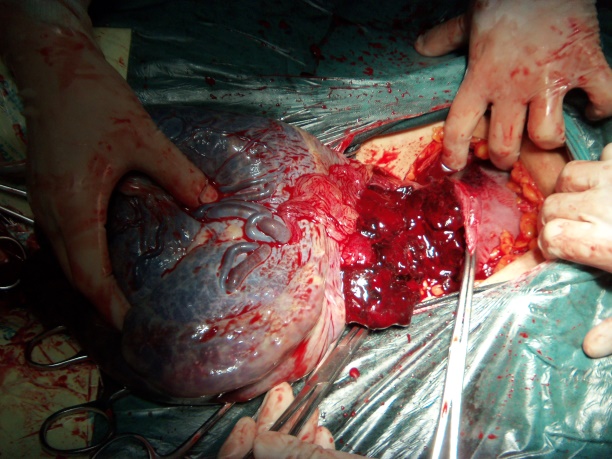
Definition: premature separation of a normally sited placenta from the uterine wall (2018CM exam tested). 2-5% of maternal deaths; significant perinatal mortality.
Risk factors: hypertension (preeclampsia/essential — strongest), trauma, smoking/cocaine, short umbilical cord, previous abruption, polyhydramnios, advanced maternal age, rapid decompression (polyhydramnios/amnioreduction).
Pathogenesis (hypertension): vasospasm → anoxic endothelial damage → decidual vessel rupture/extravasation → retroplacental haematoma → separation.
Clinical:
- Painful bleeding (80% have vaginal bleeding; ~20% CONCEALED — bleeding internal, no vaginal loss!)
- Constant abdominal pain, uterine tenderness, hypertonus/woody uterus, uterine contractions
- Rapidly rising fundal height (expanding abruption)
- Fetal distress / fetal death; hypovolaemic shock out of proportion to visible loss (concealed haemorrhage)
- Couvelaire uterus (blood extravasation into myometrium) at laparotomy; DIC (fibrinogen <200 mg/dL = severe abruption)
Diagnosis: clinical (key) + USS may show retroplacental clot — but negative USS does NOT exclude abruption. Labs: ↓Hb, ↓fibrinogen, ↑D-dimer, ↑BUN/Cr (renal), coagulopathy screen. Fetal monitoring (CTG).
Grading (Sher): Grade 1 mild; Grade 2 moderate (bleeding, uterine tenderness, fetal distress/death); Grade 3 severe (concealed, shock, coagulopathy ± fetal death).
Management:
- Resuscitate — IV fluids, crossmatch, blood products, treat DIC (FFP, cryoprecipitate, platelets).
- Immediate delivery (C-section usually) if fetal distress, maternal compromise, or ≥37 wk.
- Avoid tocolysis (contraindicated — bleeding ongoing); oxytocin cautiously for induction if stable + fetal death (or C-section per maternal indication).
- Postpartum: watch for PPH (Couvelaire uterus, coagulopathy) — uterine atony risk; treat per PPH protocol.
4. Vasa praevia (high-yield concept)
Fetal vessels (from velamentous cord insertion / bilobed placenta) run over the internal os — bleeding with rupture = fetal exsanguination. Features: painless bleeding + fetal distress (bradycardia); blood = fetal (HbF test / Apt test). Deliver by immediate C-section.
5. Premature rupture of membranes (PROM / PPROM)
| Term | Definition |
|---|---|
| PROM | Rupture of membranes at term (≥37 wk) before labour onset |
| PPROM | Rupture before 37 weeks — main concern: preterm birth + ascending infection |
Incidence: single 2-4%; multifetal 7-20%. The smaller the gestational age at PPROM, the worse the outcome.
Causes: infection (ascending, GBS), cervical incompetence, polyhydramnios, previous PPROM, smoking, vaginal bleeding.
Diagnosis: history (gush/leak), speculum exam (pooling, no VE), nitrazine test (pH >6.5 — alkaline), ferning test (microscopy), USS (oligohydramnios ±), Amnisure/IGFBP-1 test if equivocal.
Risks/complications: chorioamnionitis (major) — maternal fever, uterine tenderness, fetal tachycardia, foul discharge → deliver; preterm birth; cord prolapse; fetal pulmonary hypoplasia (very early PPROM); malpresentation.
Management:
| Gestation | Management |
|---|---|
| ≥37 wk (PROM) | Induce labour (oxytocin) if not in labour within 24 h (infection risk rises) |
| 34-36+6 wk | Consider induction vs expectant (GBS status, steroids complete); most guidelines deliver |
| <34 wk (PPROM) | Expectant + prophylactic erythromycin 10 days (or amoxicillin-clavulanate) + antenatal betamethasone + GBS prophylaxis (IV penicillin when labour); monitor for chorioamnionitis; deliver at 34 wk or on infection/compromise |
| Chorioamnionitis | Immediate delivery (vaginal or C-section per indication) + broad-spectrum antibiotics + neonatal assessment |
GBS prophylaxis: if GBS+ or unknown with risk factors → IV penicillin (or cefazolin/vancomycin) in labour — prevents neonatal early-onset GBS sepsis.
High-Yield Points
| Topic | Must-remember |
|---|---|
| APH iron rule | NO VE until praevia excluded by USS |
| Praevia | Painless bright-red bleeding; C-section delivery; TVS 100% accurate |
| Abruption | Painful + hypertonic uterus + shock out of proportion; hypertension strongest risk |
| Concealed abruption | ~20% no vaginal bleeding — shock with no visible loss |
| Abruption DIC | Fibrinogen <200 mg/dL = severe |
| Couvelaire uterus | Blood into myometrium — PPH risk postpartum |
| USS in abruption | Retroplacental clot +; negative USS doesn't exclude |
| Vasa praevia | Fetal vessels — fetal bleeding; immediate C-section |
| PPROM major risk | Chorioamnionitis + preterm birth |
| PPROM <34 wk | Erythromycin + betamethasone + GBS prophylaxis; deliver 34 wk or on infection |
| Chorioamnionitis | Deliver immediately |
| Nitrazine | Positive (alkaline) with amniotic fluid |
Topic Summary
APH is divided into placenta praevia (painless, bright-red, C-section) and placental abruption (painful, hypertonic uterus, shock ± DIC, immediate delivery, hypertension-linked) — and never do a VE before USS excludes praevia. Vasa praevia is fetal bleeding needing immediate C-section. PROM/PPROM management balances infection (chorioamnionitis → deliver) against prematurity (<34 wk → erythromycin + steroids + GBS prophylaxis, deliver at 34 wk or on compromise). Anti-D for Rh-negative women. The shared theme: bleeding and leaking are both signals — stabilise, image, diagnose, and time delivery deliberately.
LMCHK OSCE Practice — Bleeding at 34 Weeks
Station setup: A 30-year-old G2P1 at 34 weeks presents with painless bright-red vaginal bleeding (about a cupful) that started this morning. No contractions, fetal movements normal. HR 90, BP 118/72. Uterus soft, non-tender, fundal height appropriate. Fetal heart 140, reactive CTG.
Candidate tasks (8 min):
- Take a focused history (bleeding timing, pain, trauma, previous C-section, placenta praevia history).
- Recognise the differential (painless bleeding → placenta praevia first, but abruption/vasa praevia/local causes possible).
- State the first investigation — USS (TVS) to localise the placenta; do NOT do a vaginal examination.
- Outline immediate plan: IV access, FBC + crossmatch, coagulation; admit for observation; anti-D if Rh-negative; antenatal steroids (34 wk — betamethasone) in case of early delivery.
- Discuss delivery plan: if praevia confirmed and bleeding settles → expectant, elective C-section at 36-37 wk; if bleeding continues/heavy → emergency C-section.
Key marking cues:
- Refuses VE until praevia excluded — the exam-critical safety point.
- Orders USS first.
- Admits + steroids + anti-D management.
- Distinguishes praevia (painless, C-section) vs abruption (painful, deliver).
- Plans elective C-section 36-37 wk for confirmed praevia.