Preparatory Mindset
Benign gynaecological disease — uterine fibroids (leiomyoma), endometriosis/adenomyosis, and pelvic organ prolapse (POP) with urinary incontinence — is the daily bread of general gynaecology and a rich OSCE source (CM exam tested). The exam mindset: fibroids = the most common benign tumour of the female genital tract (estrogen-dependent; symptomatic pattern by location — submucosal = heavy bleeding); endometriosis = the "chocolate cyst" and the laparoscopy diagnosis; prolapse = the POP-Q staging and the pessary/ring options. The common thread: these are benign, estrogen- and childbirth-related conditions — you treat symptoms, preserve fertility when possible, and escalate to surgery (myomectomy vs hysterectomy, sling vs pessary) deliberately.
Core Concepts
1. Uterine leiomyoma (fibroid / myoma)
Definition: benign fibromuscular tumour of the myometrium — the most common benign gynaecological tumour (~20-40% of reproductive-age women; black women higher incidence).
Aetiology:
- Estrogen-dependent — grow in reproductive years, with pregnancy (1/3 grow in 1st trimester), and shrink after menopause; HT after menopause may reactivate symptoms.
- Risk factors: early menarche, family history (first-degree), obesity, hypertension, red meat diet, alcohol/caffeine; nulliparity.
- Genetics: ~40-50% have chromosomal abnormalities; monoclonal smooth muscle cell proliferation (stem cell mutation theory).
Classification by location:
| Type | Location | Clinical |
|---|---|---|
| Intramural | In the myometrial wall (most common) | Often asymptomatic; heavy bleeding if large |
| Subserosal | Outer wall, may become pedunculated | Pressure on bladder/bowel, pain, torsion of pedicle |
| Submucosal | Just under the endometrium, may protrude into cavity (rarest but most symptomatic) | Heavy/prolonged bleeding (menorrhagia), infertility, miscarriage |
| Cervical | Cervix (~10% of fibroids) | Pressure, bleeding |
Pathology: well-circumscribed whorled ("swirling") smooth muscle bundles; pseudoencapsulation (compressed surrounding myometrium — not a true capsule); microscopic spindle-shaped smooth muscle cells with blunt-ended "cigar" nuclei (no mitoses — benign).
Symptoms: asymptomatic (most), menorrhagia (submucosal), pelvic pressure/pain, urinary frequency, constipation, subfertility, pregnancy complications (pain, red degeneration, malpresentation, PPROM).
Diagnosis: USS (TVS) first-line; saline infusion sonography (SIS) / hysteroscopy for submucosal detail; MRI for mapping/sizing (myomectomy planning); biopsy rarely needed (benign appearance).
Management:
| Setting | Option |
|---|---|
| Asymptomatic | Surveillance (annual USS if growing) |
| Symptomatic + fertility desired | Myomectomy (hysteroscopic for submucosal; abdominal/laparoscopic for intramural/subserosal) — preserves fertility |
| Symptomatic + no fertility desire | Mirena IUS (bleeding control), tranexamic acid, NSAIDs, OCP, GnRH-a (pre-operative shrinkage, short-term ≤6 months — bone loss), UAE (uterine artery embolisation), endometrial ablation (submucosal only), hysterectomy (definitive) |
| Pregnancy | Usually conservative; red degeneration (pain, fever) → analgesia; surgery avoided |
Red degeneration — infarction/necrosis in pregnancy — acute pain, fever, WBC ↑; treated symptomatically.
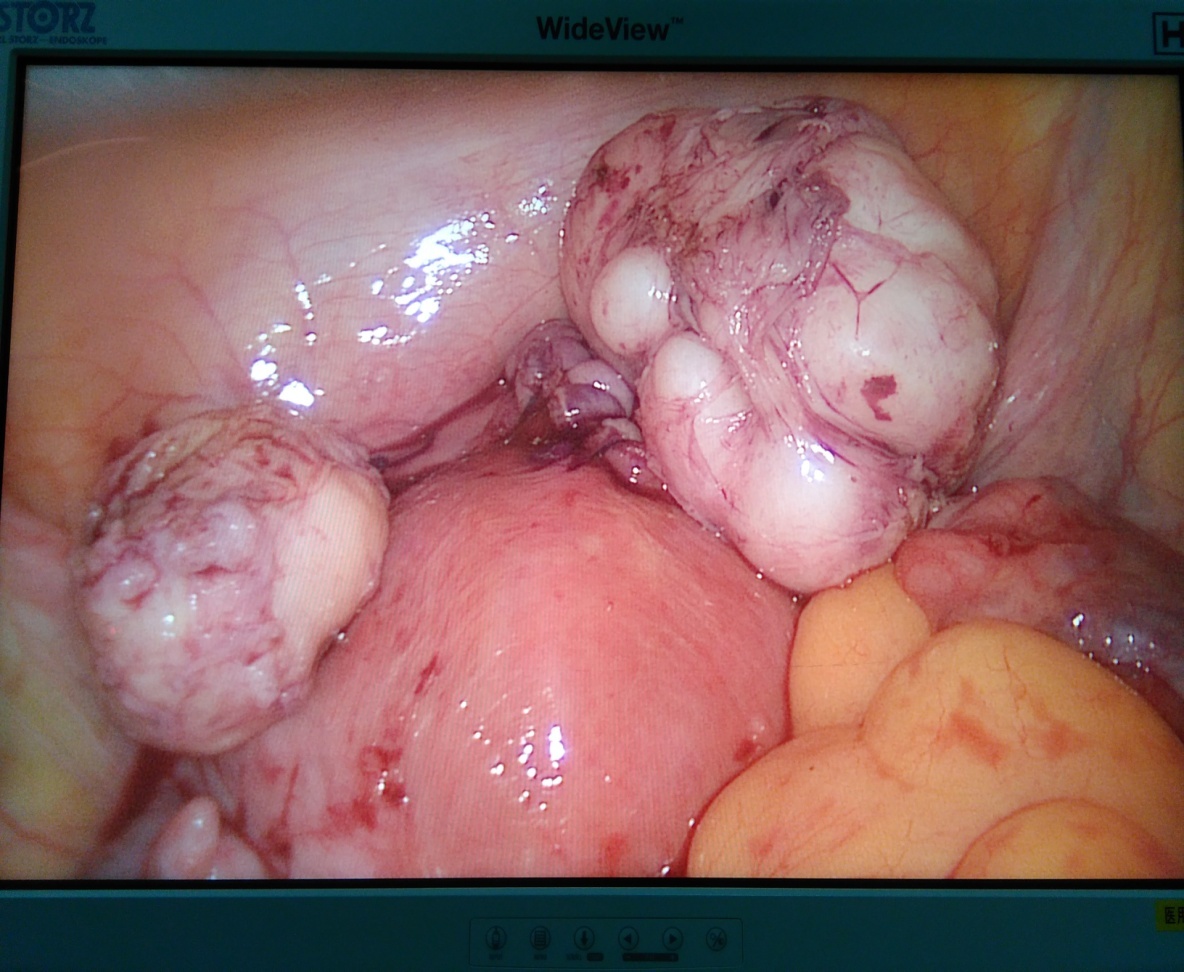
2. Endometriosis and adenomyosis
Endometriosis: functional endometrial glands/stroma outside the uterus (ovary — chocolate cyst/endometrioma, peritoneum, pouch of Douglas, uterosacral ligaments, rarely bowel/bladder/lungs).
- Analgesia + NSAIDs (mild). - Hormonal suppression (do NOT cure, suppress): COCP (continuous), progestogens, Mirena IUS, GnRH-a, danazol (less used). - Surgical: laparoscopic excision/ablation of implants + cystectomy for endometrioma; hysterectomy + bilateral salpingo-oophorectomy ± excision for severe refractory disease (definitive, with HRT considerations). - Fertility: surgical treatment improves; IVF if required. - Recurrence is common — long-term hormonal maintenance.
- Aetiology: retrograde menstruation (Sampson), coelomic metaplasia, lymphatic spread, genetic/immune factors.
- Symptoms: secondary dysmenorrhoea (worse, progressive), deep dyspareunia, chronic pelvic pain, subfertility (inflammation, adhesions, tubal/ovarian damage), cyclical bowel/bladder symptoms, premenstrual spotting.
- Signs: tender uterosacral nodules, fixed retroverted uterus, adnexal mass (endometrioma).
- Diagnosis: clinical + USS (endometrioma = ground-glass cystic lesion); laparoscopy is the gold standard (blue/black/brown peritoneal implants, powder-burn lesions); CA-125 mild elevation (not diagnostic).
- Management:
Adenomyosis: endometrial glands/stroma within the myometrium — bulky, tender, globular/soft "boggy" uterus, heavy painful periods; USS/MRI diagnosis (thickened junctional zone); treatment similar (Mirena, GnRH-a, hysterectomy definitive).
3. Pelvic organ prolapse (POP)
Definition: descent of pelvic organs (anterior = cystocele, posterior = rectocele/enterocele, apical = uterine/vault prolapse).
Risk factors: childbirth (vaginal delivery — the dominant factor), multiparity, instrumental delivery, advancing age, menopause (estrogen loss), chronic raised intra-abdominal pressure (constipation, heavy lifting, COPD, obesity), connective tissue disorders.
Symptoms: vaginal bulge/pressure, backache, urinary symptoms (stress incontinence, voiding difficulty, recurrent UTI), bowel symptoms (incomplete emptying), dyspareunia, sexual dysfunction.
Diagnosis: clinical with POP-Q staging (0-IV) — record the most descended point relative to the hymen; assess cough stress test, voiding trial.
Management:
| Grade / patient | Option |
|---|---|
| Mild (I-II), asymptomatic | Surveillance + lifestyle (weight, avoid straining, pelvic floor muscle training) |
| Symptomatic, wants conservative | Pessary (ring, shelf, cube) — first-line non-surgical; vaginal estrogen cream (atrophic change) |
| Symptomatic, surgery desired | Anterior/posterior colporrhaphy, sacrospinous/sacral colpopexy, vaginal hysterectomy (uterine prolapse), obliterative procedures (elderly, no sexual activity) |
| Recurrent/poor tissue | Mesh/sacrocolpopexy (with counselling on mesh risks) |
4. Urinary incontinence
| Type | Features | Treatment |
|---|---|---|
| Stress incontinence (SUI) | Leak on cough/sneeze/laugh/exercise (raised intra-abdominal pressure) | Pelvic floor muscle training (first-line), pessary, vaginal estrogen, mid-urethral sling (TVT/TOT) — surgical cure |
| Urgency incontinence (UUI/OAB) | Leak with sudden urge; frequency, nocturia; overactive bladder | Bladder training, anticholinergics (oxybutynin, tolterodine), mirabegron (β3-agonist), botulinum toxin, neuromodulation |
| Mixed | Both components | Treat dominant first |
| Overflow | Incomplete emptying, constant dribble; retention | Catheterisation, treat cause (prolapse, neurological) |
Workup: history (voiding diary), cough stress test, urinalysis, post-void residual (PVR), urodynamics (if surgery planned / diagnostic doubt), Q-tip/Marshall test (mobility).
High-Yield Points
| Topic | Must-remember |
|---|---|
| Fibroid | Most common benign gynaecological tumour; estrogen-dependent |
| Submucosal fibroid | Most symptomatic — menorrhagia, infertility |
| Red degeneration | Pain + fever in pregnancy — conservative |
| Myomectomy | Preserves fertility; hysterectomy = definitive |
| GnRH-a | Pre-op shrinkage; ≤6 months (bone loss) |
| Endometriosis | Laparoscopy = gold standard; chocolate cyst (endometrioma) |
| Endometriosis treatment | Suppression (COCP, Mirena, GnRH-a) vs excision; recurrence common |
| Adenomyosis | Endometrium in myometrium — boggy tender uterus |
| POP risk | Vaginal delivery is dominant risk |
| POP-Q staging | 0-IV; pessary first-line conservative |
| SUI | Pelvic floor exercises first; mid-urethral sling surgical |
| UUI | Bladder training + anticholinergics/mirabegron |
Topic Summary
Uterine fibroids — the most common benign tumour — are classified by location (submucosal = bleeding/infertility, intramural = most common, subserosal = pressure) and managed by surveillance, symptom control (Mirena/tranexamic acid), myomectomy (fertility-sparing), or hysterectomy (definitive). Endometriosis/adenomyosis cause progressive pain and subfertility; diagnosed by laparoscopy; treated with hormonal suppression and surgical excision. Pelvic organ prolapse (POP-Q staging; pessary vs surgery) and urinary incontinence (SUI = pelvic floor training/sling; UUI = bladder training/anticholinergics) complete the "benign gyn" picture. The theme: benign conditions — treat symptoms, preserve fertility, escalate surgery deliberately.
LMCHK OSCE Practice — Fibroid Counselling (Fertility Desired)
Station setup: A 34-year-old woman, trying to conceive, presents with heavy periods and a 4-cm submucosal fibroid on USS. Hb 100 g/L. She asks about treatment and her fertility.
Candidate tasks (8 min):
- Explain the diagnosis (submucosal fibroid — location explains heavy bleeding; may affect implantation).
- Discuss the fertility impact: submucosal fibroids associated with menorrhagia, subfertility, miscarriage; removal may improve outcome.
- Present management options with fertility in mind: hysteroscopic myomectomy (the preferred fertility-sparing option for submucosal); short-term GnRH-a pre-op (but caution — don't delay conception unnecessarily); avoid hysterectomy/UAE (UAE can affect ovarian function).
- Address the anaemia (iron; tranexamic acid short-term) and the surgical risks (perforation, adhesion).
- Plan preconception counselling and timing of conception after surgery.
Key marking cues:
- Recognises submucosal location = bleeding + fertility relevance.
- Recommends hysteroscopic myomectomy as fertility-sparing.
- Avoids hysterectomy/UAE in a woman who wants children.
- Treats anaemia and plans conception timing.