Preparatory Mindset
Child development is the backbone of paediatrics — growth and development milestones are the "vital signs" of childhood, and every paediatric exam has at least one milestone question or OSCE station. The mindset: know the key milestones by age (the "can't walk by 18 months = assess" rule, the social smile, sitting, crawling, first words, the pincer grasp), understand the primitive reflexes and when they disappear, and recognise that motor milestones are a poor predictor of cognition — speech and language predict better. For OSCE: a developmental assessment station asks you to take a developmental history (four domains: gross motor, fine motor/vision, hearing/speech/language, social/emotional/behaviour), plot growth, and flag deviations for referral. Genetics adds the dysmorphology dimension — a child with multiple anomalies → think syndrome → karyotype/microarray.
Core Concepts
1. Why development matters
- Development = acquisition of skills across four domains: gross motor, fine motor & vision, hearing & speech & language, social & emotional & behaviour.
- Developmental screening compares the child's achievements against age limits (the age by which most children have achieved a milestone) — a child missing a milestone beyond the limit needs assessment.
- Speech/language development is a better predictor of cognitive function than motor development (motor delay correlates poorly with later IQ; speech delay correlates better).
- Early detection (e.g., hearing impairment → language) improves outcomes — screening matters.
2. Key developmental milestones (by median age)
| Age | Gross motor | Fine motor / vision | Hearing / speech / language | Social / emotional / behaviour |
|---|---|---|---|---|
| 6 weeks | Lifts head when prone | Fixes and follows face | Startles to sound | Social smile |
| 4 months | Head control (no lag on pull-to-sit) | Reaches for objects, grasps | Coos; turns to voice | Laughs |
| 6 months | Sits (with support), rolls | Transfers objects hand-to-hand | Babbles | Recognises strangers (stranger anxiety) |
| 9 months | Sits unsupported, crawls | Pincer grip (developing), bangs toys | Mama/dada (nonspecific) | Stranger anxiety peaks; plays peek-a-boo |
| 12 months | Stands alone, cruises, first steps | Pincer grip precise; points | First words (mama/dada specific) | Waves bye-bye |
| 15 months | Walks independently | Scribbles with crayon | 3-6 words | Points to wants |
| 18 months | Runs, climbs stairs (hand-held) | Builds tower of 2-3 blocks | 10+ words; names pictures | Uses spoon; tantrums begin |
| 2 years | Kicks ball, jumps | Tower of 6-7 blocks | Two-word phrases | Parallel play; toileting starts |
| 3 years | Tricycle; stands on one foot | Copies a circle, tower of 9 | Three-word sentences; knows name/age | Cooperative play; fears |
| 4 years | Hops on one foot | Copies a square, cross | Fluent sentences; counts | Dresses/undresses |
| 5 years | Skips | Copies a triangle; ties shoelaces | Full sentences; letters | School readiness |
The rule to remember: "Any child not walking by 18 months should be assessed and examined." — but note *normal late walkers exist* (many walk 12-18 months); the red flag is no independent walking at 18 months.
Other key ages: head control 4 mo, sitting 6-9 mo, first words 12 mo, two-word phrases 2 yr, sentences 3 yr.
3. Primitive reflexes and their disappearance
| Reflex | Present from | Disappears by |
|---|---|---|
| Moro | Birth | ~3-4 months |
| Palmar grasp | Birth | ~3-4 months |
| Rooting | Birth | ~3-4 months |
| Sucking | Birth | ~4-6 months |
| Tonic neck (fencing) | Birth | ~4-6 months |
| Parachute (protective) | ~7-9 months | Persists |
Persistence of primitive reflexes beyond their expected disappearance → CNS pathology (cerebral palsy, hypotonia, kernicterus).
4. Growth parameters
- Weight: doubles by ~5 months, triples by 1 year; 2-3 kg/year after.
- Length/height: ~50 cm at birth, 75 cm at 1 year, ~2× birth length by 4 years.
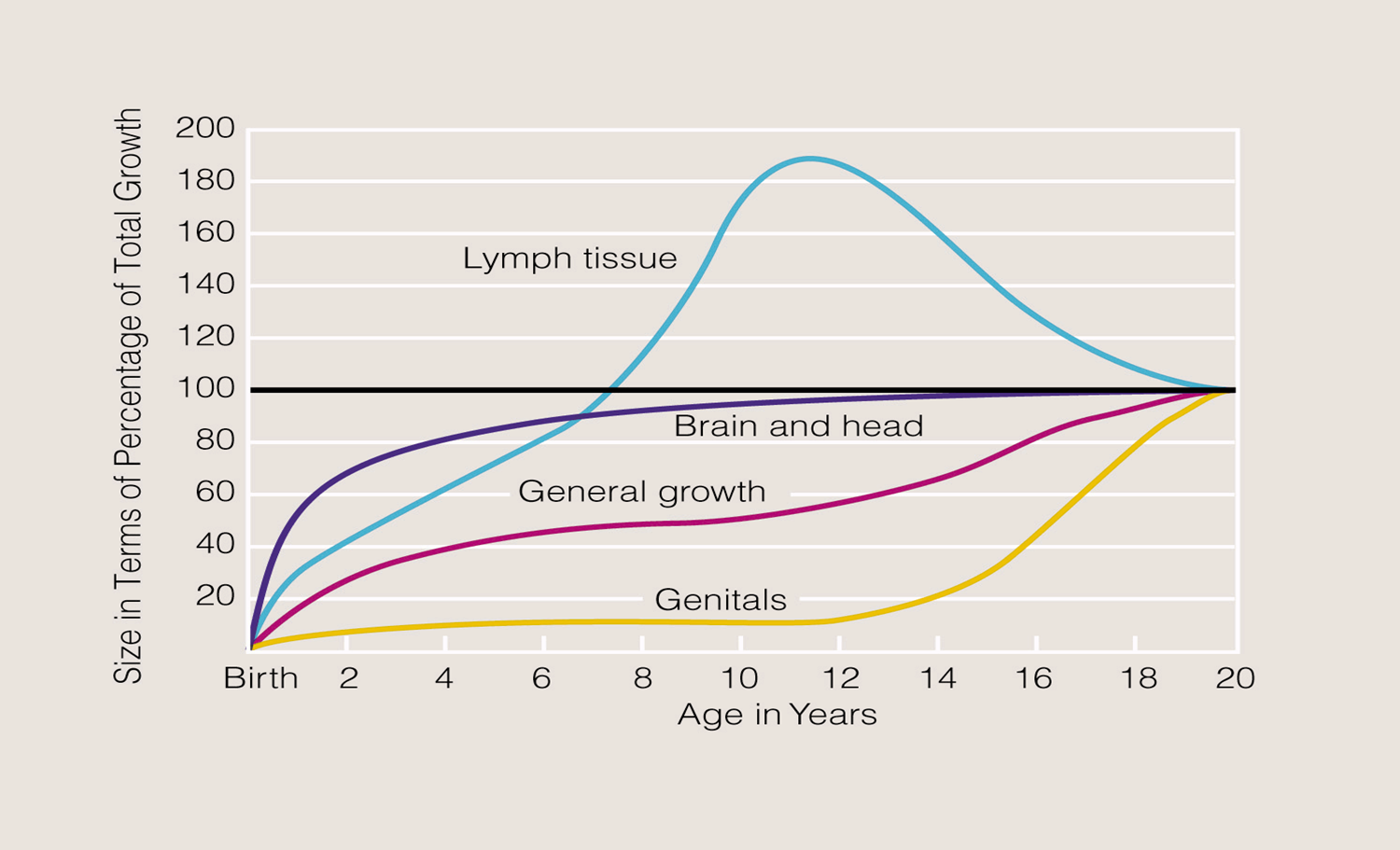
- Head circumference: fastest in infancy — growth of head circumference in first 2 years reflects brain growth; crossing centiles = investigate (macro/microcephaly).
- Teething: first tooth ~6 months; ~20 deciduous teeth by 2.5-3 years.
- Plot on WHO growth charts (weight/height/head circumference for age); crossing centiles downward = growth concern.
5. Developmental assessment (OSCE format)
- History — each domain, with age-appropriate questions (birth history, hearing, vision, schooling, social interaction).
- Examination — observe, plot growth, check for dysmorphism, neurological exam (reflexes).
- Screening tools — ASQ (Ages & Stages), Denver II, M-CHAT (autism screen).
- Red flags requiring referral: not walking at 18 months, no speech by 2 years, loss of skills (regression → consider autism, metabolic, neurodegenerative), asymmetric motor skills (hemiplegia), persistent primitive reflexes, no social smile by 3 months.
6. Developmental disorders (high-yield)
| Disorder | Key features |
|---|---|
| Global developmental delay (GDD) | Delay in ≥2 domains (<5 years) — investigate: karyotype, microarray, metabolic, hearing, vision |
| Intellectual disability (ID) | IQ <70 + adaptive impairment (≥5 years) |
| Autism spectrum disorder (ASD) | Impaired social interaction + communication + restricted/repetitive behaviour; regression of language; M-CHAT screen; early behavioural intervention improves outcome |
| Cerebral palsy (CP) | Non-progressive motor disorder from brain insult; spastic (most common, 70-80%), dyskinetic, ataxic; associated: epilepsy, learning disability |
| ADHD | Inattention + hyperactivity + impulsivity (before 12); multi-setting; stimulant therapy |
| Specific learning disorders | Dyslexia (reading), dyscalculia (math) — normal IQ |
7. Paediatric genetics (essentials)
- Karyotype: chromosomal number/structure (trisomy 21 — Down; Turner 45,X; Klinefelter 47,XXY).
- Microarray (aCGH): microdeletions/duplications (22q11 — DiGeorge).
- Single-gene disorders: autosomal dominant (achondroplasia, NF1), recessive (CF, thalassaemia, sickle cell), X-linked (DMD, haemophilia).
- Down syndrome (trisomy 21): most common chromosomal anomaly — intellectual disability, characteristic facies (flat occiput, upslanting palpebral fissures, epicanthic folds, protruding tongue), single palmar crease, congenital heart disease (~50% — AVSD, VSD), duodenal atresia, atlantoaxial instability, early Alzheimer — screening (NT + combined test; NIPT; amniocentesis).
- Maternal age >35 increases trisomy risk; consanguinity increases recessive disorders.
- Dysmorphic child + anomalies → referral for genetic evaluation (microarray first-line).
High-Yield Points
| Topic | Must-remember |
|---|---|
| Social smile | 6 weeks |
| Head control | 4 months |
| Sit unsupported | 6-9 months |
| Pincer grip | 9 months |
| First words | 12 months |
| Two-word phrases | 2 years |
| Three-word sentences | 3 years |
| Not walking by 18 months | Assess and examine |
| Moro reflex | Birth-3 months; persistence = CNS pathology |
| Parachute reflex | ~7-9 months, persists |
| Weight | Triples by 1 year |
| Height | ~75 cm at 1 year |
| Head circumference | Reflects brain growth in first 2 years |
| ASD | Social + communication + repetitive; regression = red flag |
| CP | Non-progressive motor; spastic most common |
| Down syndrome | Trisomy 21; CHD ~50% (AVSD); maternal age >35 |
| Speech > motor | Speech/language predicts cognition better |
Topic Summary
Child development is assessed across four domains (gross motor, fine motor/vision, speech/language, social/emotional) with age-limit milestones — social smile 6 wk, head control 4 mo, sitting 6-9 mo, pincer 9 mo, first words 12 mo, phrases 2 yr, sentences 3 yr. Not walking by 18 months = assess. Primitive reflexes (Moro, grasp, rooting) disappear by 3-6 months; persistence suggests CNS pathology. Growth is tracked on WHO charts (weight triples by 1 yr). Speech/language predicts cognition better than motor skills. Developmental disorders — GDD, ID, ASD (regression = red flag), CP (spastic most common), ADHD — and genetics (Down syndrome + CHD, karyotype/microarray) complete the picture.
LMCHK OSCE Practice — Developmental Assessment
Station setup: A mother brings her 15-month-old son for a routine check. She is worried because "he doesn't walk yet and only says a few sounds." He sits unsupported, crawls well, stands holding furniture, has a developing pincer grip, babbles, and waves bye-bye. Examination normal.
Candidate tasks (8 min):
- Take a developmental history in all four domains (birth history, gross motor, fine motor/vision, hearing/speech/language, social/emotional).
- Plot growth on the WHO chart; assess reflexes.
- Reassure appropriately: at 15 months, cruising but not yet walking independently is within normal limits (most walk by 12-18 months); babbling with emerging words is normal — not yet a red flag.
- Explain the "not walking by 18 months" threshold and when to be concerned.
- Offer hearing screen (language delay link) and follow-up in 3 months.
Key marking cues:
- Assesses all four domains, not just walking.
- Knows 15-month norms (cruise → independent walk by 18 mo; 10+ words by 18 mo).
- Does not over-refer a normal 15-month-old, but sets a clear red-flag threshold (18 months).
- Links speech to hearing — offers audiology.
- Gives a follow-up plan.