Preparatory Mindset
Infant nutrition and childhood malnutrition are fundamental paediatric topics — "breast is best" is the anchor, and malnutrition (kwashiorkor vs marasmus) + rickets (vitamin D deficiency) are the two classic exam diseases (17CM & 18CM exam tested). The mindset: infant feeding = exclusive breastfeeding to 6 months, weaning solids from ~6 months, no cow's milk before 12 months (iron deficiency link); malnutrition is classified by wasting (weight-for-height — acute), stunting (height-for-age — chronic), and underweight (weight-for-age); kwashiorkor = protein deficiency with oedema, marasmus = overall energy deficit (wasted); rickets = vitamin D/calcium/phosphate deficiency → bone softening — wrist cupping/fraying on X-ray, rachitic rosary, bow legs — treat with vitamin D + calcium. The OSCE: growth faltering assessment and nutrition counselling.
Core Concepts
1. Infant feeding — "breast is best"
| Aspect | Key points |
|---|---|
| Colostrum | First few days; higher protein + immunoglobulin content; small volumes — no water/formula supplements needed |
| Exclusive breastfeeding | Recommended to 6 months (no water, juice, or solids) |
| Breastfeeding duration | Continue to 12 months (advantages to 18 months); weaning onto solids from ~6 months |
| Breast milk advantages | Ideal nutrient composition; immunoglobulins/anti-infective; lower infection rates (GI, respiratory, otitis); ↓ allergy/eczema; long-term ↓ obesity/T2DM; maternal benefits (↓ breast/ovarian cancer, T2DM); economic |
| Formula | Based on modified cow's milk — unmodified cow's milk unsuitable for infancy (too much protein/electrolytes, inadequate iron/vitamins); no brand superior; WHO Code of Marketing (1981) prohibits advertising formula |
| Cow's milk <12 months | Associated with increased iron deficiency — not before 1 year; after 1 year pasteurised cow's milk OK (with good solids) |
| Common weaning problems | Iron deficiency (late weaning, cow's milk), obesity (overfeeding), food refusal |
Iron/vitamin supplements: breastfed infants need vitamin D from birth (400 IU/day) and iron from ~4-6 months if exclusively breastfed.
2. Malnutrition — definitions and classification
Growth parameters:
| Parameter | Definition | Meaning |
|---|---|---|
| Wasting | Weight-for-height < −2 SD (or <80%) | Acute malnutrition (current deficit) |
| Stunting | Height-for-age < −2 SD | Chronic malnutrition (long-term) |
| Underweight | Weight-for-age < −2 SD | Combined indicator |
| Severe acute malnutrition (SAM) | Weight-for-height < −3 SD, or MUAC <115 mm (6-59 mo), or bilateral pitting oedema | Emergency; high mortality |
Clinical syndromes:
| Type | Cause | Features |
|---|---|---|
| Kwashiorkor | Protein deficiency (adequate energy, low protein) | Oedema (pitting, from hypoalbuminaemia), fatty liver, hair changes (sparse, depigmented, "flag sign"), skin changes (flaky paint dermatosis), anorexia, apathy; swollen "moon face" |
| Marasmus | Overall energy/protein deficit | Severe wasting (no fat/muscle), "old man" face, thin, prominent ribs, no oedema, alert but irritable |
| Marasmic-kwashiorkor | Combined | Wasting + oedema |
Causes: inadequate intake (poverty, neglect, feeding errors), repeated infections (diarrhoea, measles), malabsorption, chronic disease.
Complications (the "10 steps"): hypoglycaemia, hypothermia, dehydration, infection, micronutrient deficiency, refeeding syndrome (hypophosphataemia on refeeding — risk of death), heart failure, electrolyte imbalance (CM exam tested).
Management of SAM (WHO):
- Treat/identify complications first — hypoglycaemia (glucose), hypothermia (warm), dehydration (careful — rehydrate slowly, oral), infection (broad-spectrum antibiotics — empiric in SAM).
- Feeding: start with F-75 formula (stabilisation phase, low protein/energy) → then F-100 (catch-up) or Ready-to-Use Therapeutic Food (RUTF) at home.
- Micronutrients: vitamin A, folate, zinc, iron (once infection controlled), potassium/magnesium.
- Refeeding syndrome prevention: start small, increase gradually, monitor phosphate/K/Mg.
- Treat the underlying cause + follow-up (prevent relapse).
3. Rickets (vitamin D deficiency)
Definition: defective bone mineralisation from vitamin D, calcium, or phosphate deficiency — the growing skeleton "softens."
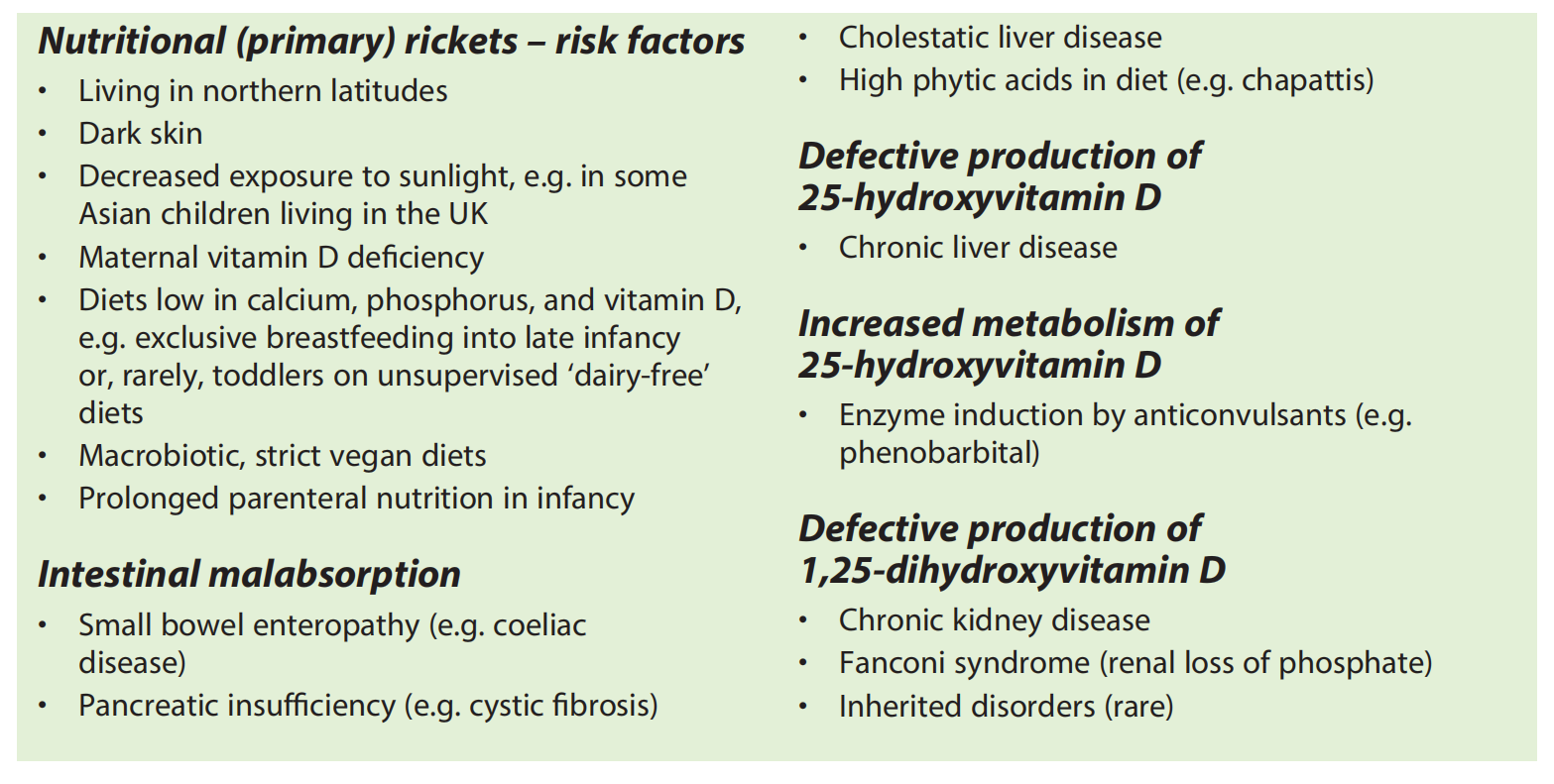
Aetiology: vitamin D deficiency (most common) — inadequate sunlight, dark skin, exclusive breastfeeding without supplementation, malabsorption; calcium deficiency; phosphate deficiency (X-linked hypophosphataemic rickets — genetic); renal (1α-hydroxylase deficiency); anticonvulsants (enzyme induction).
Clinical features (infants/children):
- Skeletal: widening of wrists/ankles, rachitic rosary (beading of costochondral junctions), Harrison sulcus (indentation at diaphragm), frontal bossing, craniotabes (soft skull), bow legs (genu varum) / knock knees, delayed fontanelle closure, delayed walking, pathological fractures.
- Systemic: hypotonia, poor growth, irritability, hypocalcaemic seizures/tetany (severe), delayed dentition.
Investigations:
| Test | Rickets (vitamin D) |
|---|---|
| Serum calcium | Low or normal |
| Serum phosphate | Low |
| ALP (alkaline phosphatase) | Markedly elevated (bone formation marker) |
| 25(OH)D | Low (<30 nmol/L) |
| PTH | Elevated (secondary hyperparathyroidism) |
| X-ray wrist | Cupping and fraying of metaphyses, widened epiphyseal plate |
Management:
- Vitamin D — high-dose stoss (e.g., 150,000-600,000 IU total oral, over days-weeks) then maintenance 400-600 IU/day; ensure calcium intake (calcium supplement alongside — prevents hypocalcaemic tetany).
- Correct underlying cause; dietary calcium; sunlight.
- Follow-up — X-ray healing (metaphyseal recalcification), ALP fall.
Prevention: vitamin D 400 IU/day for all infants (breastfed) from birth; adequate sunlight; fortified formula.
High-Yield Points
| Topic | Must-remember |
|---|---|
| Exclusive breastfeeding | To 6 months; continue to 12 months (advantages 18 mo) |
| Colostrum | High protein + immunoglobulin |
| Cow's milk <12 months | Iron deficiency risk — not before 1 year |
| Vitamin D | 400 IU/day all infants from birth |
| Wasting | Weight-for-height — acute |
| Stunting | Height-for-age — chronic |
| SAM | WFH <−3 SD, MUAC <115 mm, or oedema |
| Kwashiorkor | Protein deficiency + oedema + fatty liver + hair/skin changes |
| Marasmus | Energy deficit — wasting, no oedema |
| SAM complications | Hypoglycaemia, hypothermia, infection, refeeding syndrome |
| SAM feeding | F-75 → F-100 / RUTF |
| Rickets cause | Vitamin D deficiency (sunlight, breastfed unsupplemented) |
| Rickets labs | ↓ PO₄, ↑ ALP, ↓ 25(OH)D, ↑ PTH |
| Rickets X-ray | Wrist cupping/fraying, widened epiphyseal plate |
| Rickets features | Rachitic rosary, bow legs, frontal bossing |
| Rickets treatment | Vitamin D (stoss) + calcium |
Topic Summary
Infant nutrition: exclusive breastfeeding to 6 months, solids from ~6 months, cow's milk only after 12 months (iron deficiency link); breast milk is superior (anti-infective, ideal composition). Malnutrition: wasting (acute, weight-for-height), stunting (chronic, height-for-age), SAM = severe wasting/oedema; kwashiorkor = protein deficiency with oedema, marasmus = energy deficit with wasting; SAM management = treat hypoglycaemia/hypothermia/infection + F-75→F-100/RUTF + watch for refeeding syndrome. Rickets: vitamin D deficiency → ↓PO₄, ↑ALP, ↓25(OH)D + wrist cupping/fraying; features = rachitic rosary, bow legs, frontal bossing; treatment = vitamin D + calcium; prevention = daily vitamin D.
LMCHK OSCE Practice — Growth Faltering in a Toddler
Station setup: A 2-year-old boy is brought by his grandmother, who feeds him mostly rice porridge and tea, with very little meat, egg, or milk. He has bilateral pitting oedema of the feet and legs, sparse depigmented hair, an apathetic look, and a distended abdomen. Weight-for-age <−3 SD, weight-for-height <−3 SD.
Candidate tasks (8 min):
- Take a feeding history (diet composition, frequency, prior infections, hygiene).
- Recognise kwashiorkor (protein deficiency: oedema + hair changes + apathy) and SAM (severe anthropometric deficit).
- Outline immediate management: admit; treat hypoglycaemia (glucose), hypothermia, dehydration (slow oral rehydration), empiric broad-spectrum antibiotics (SAM = immune compromised); micronutrients (vitamin A, folate, zinc).
- Feeding plan: F-75 (stabilisation) → F-100/RUTF (catch-up); refeeding syndrome watch (phosphate, K, Mg).
- Counsel the family on diet diversification (energy + protein + micronutrients) and follow-up to prevent relapse.
Key marking cues:
- Distinguishes kwashiorkor (oedema) vs marasmus (wasting).
- Treats complications first (hypoglycaemia, infection) before feeding.
- Uses F-75 → F-100/RUTF protocol.
- Watches for refeeding syndrome.
- Gives nutrition counselling and follow-up.