Preparatory Mindset
The basic and general physical examination is the cornerstone of clinical diagnosis. Master the five methods (inspection, palpation, percussion, auscultation, olfaction), the systematic order (general → head → neck → chest → abdomen → spine → limbs → nervous system), and the principles of professionalism, privacy, and infection control. Remember the 73855 rule and 3C1H for every exam. The general exam (vital signs, development, nutrition, consciousness, skin, lymph nodes) often gives the diagnosis before you even touch the stethoscope (19CM exam tested).
Illustrations(图解速览)
Core Concepts — Principles & Methods
Basic Rules
- Treat the patient with courtesy, kindness, professionalism; warm, well-lit room; adequate privacy
- Explain each step; hand hygiene before and after; systematic approach with differentials in mind
- Male physicians: never examine a female patient alone in a closed room; children with parents present
- Systematic order: General → Head → Neck → Chest → Abdomen → Spine → Limbs → Nervous system
- Inspection → Palpation → Percussion → Auscultation (exception: abdomen — auscultation BEFORE percussion/palpation)
- Compare bilaterally; right side of patient; expose only the area examined
Five Basic Methods
| Method | What you assess | Key points |
|---|---|---|
| Inspection (视诊) | Visual — general & local appearance | Age, development, nutrition, facies, consciousness, posture, skin, contours, symmetry |
| Palpation (触诊) | Touch — temperature, moisture, texture, tenderness, fremitus, masses, organs | Light (~1 cm) vs deep (>2 cm); fingertips (touch), palm (vibration), dorsum (temp) |
| Percussion (叩诊) | Sound — density of underlying structures | Indirect (finger-on-finger) vs direct; wrist movement only |
| Auscultation (听诊) | Sound — heart, lungs, vessels, abdomen | Diaphragm (high-pitched), bell (low-pitched) |
| Olfaction (嗅诊) | Smell — breath, body odors | Fruity (ketones), fetor hepaticus, uremic |
Hand Hygiene — 7 Steps (内外夹弓大立腕)
- Rub palm to palm (内)
- Right palm over left dorsum, interlaced, and vice versa (外)
- Palm to palm, fingers interlaced (夹)
- Backs of fingers to opposing palms, fingers interlocked (弓)
- Rotational rubbing of clasped left thumb (大)
- Rotational rubbing, backward/forward, clasped fingers in palm (立)
- Rotational rubbing of left wrist (腕) → rinse, dry
Palpation Methods
- Light palpation (~1 cm): tenderness, superficial masses, pulsations, guarding
- Deep sliding palpation (>2 cm): deep masses, GI tract; slide perpendicular to long axis of cord-like masses
- Bimanual palpation: left hand supports/lifts organ (liver, spleen, kidneys); palpate during deep breathing
- Deep press palpation: 2–3 s sustained pressure; rebound tenderness test (lift hand quickly — pain intensifies = peritonitis)
- Ballottement (浮沉触诊): rapid firm impulses at 70–90° — palpate liver/spleen obscured by ascites
Core Concepts — General Examination
Vital Signs
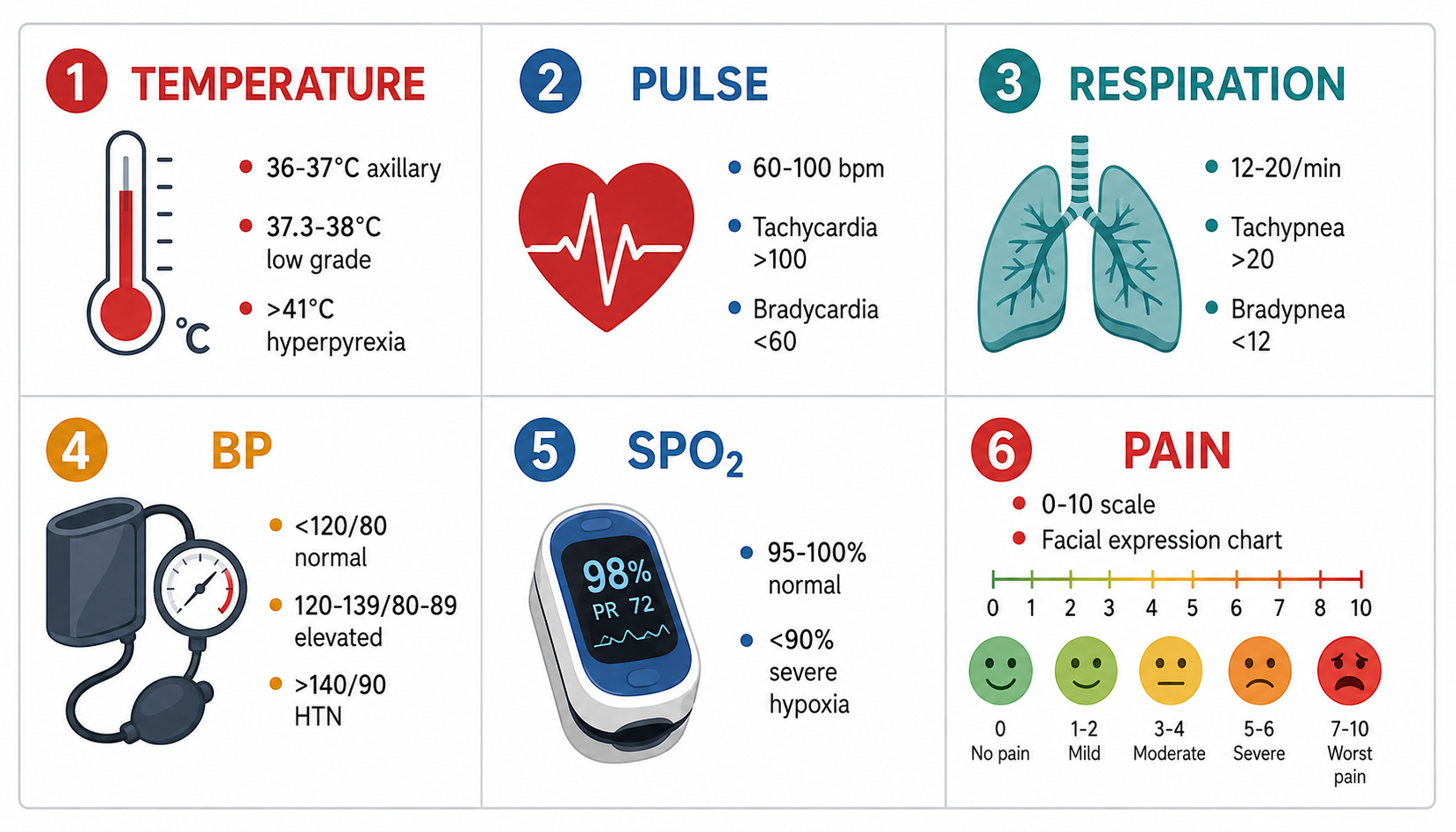
- Body temperature: axillary 36–37℃ (10 min); oral 36.3–37.2℃ (5 min); rectal 36.5–37.7℃ (5 min, most stable); daily variation <1℃
- Pulse: normal 60–100 bpm; <60 bradycardia, >100 tachycardia; regularity, volume (weak = shock), character (water-hammer = AR), radio-femoral delay (coarctation)
- Respiration: 12–20/min; tachypnea >20 (fever, pain, anemia, HF); bradypnea <12 (narcotics, ↑ICP); Kussmaul (deep/slow = metabolic acidosis); Cheyne-Stokes (crescendo-decrescendo + apnea, cortical lesion/CHF); Biot's (irregularly irregular, medullary lesion)
- Blood pressure: measure with cuff; Korotkoff sounds; hypertension ≥140/90; orthostatic hypotension (↓SBP ≥20 or ↓DBP ≥10 on standing)
Development, Nutrition, Facies, Consciousness
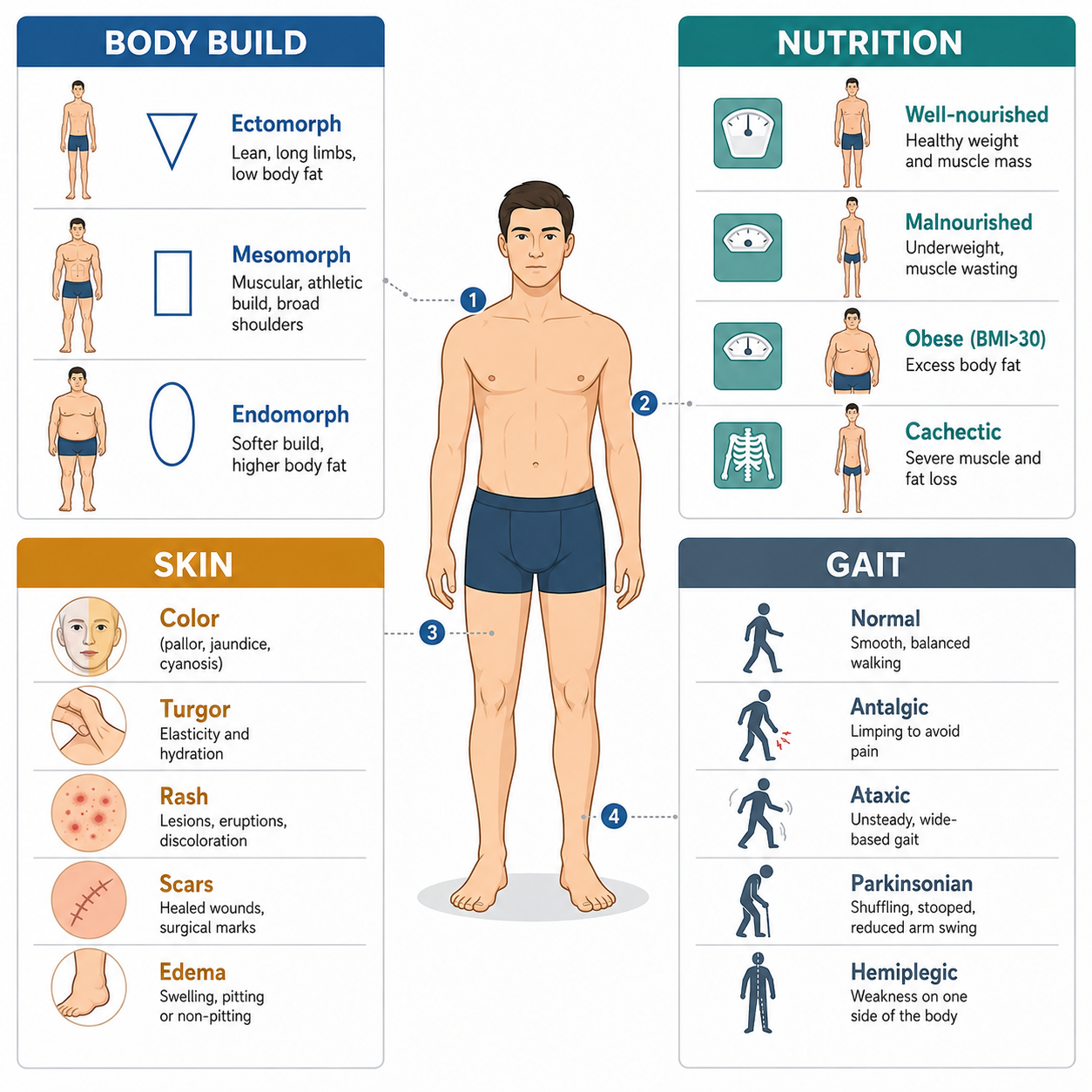
- Development (发育): ortho-sthenic (normal), asthenic (poor), sthenic (super-normal)
- Nutrition (营养): well, fairly, poor, cachexia (恶病质)
- Facies (面容): acute (fever, flushed), chronic, mitral (mitral stenosis — flushed cheeks), moon face (Cushing), thyrotoxic (exophthalmos, staring), myxedema (puffy, non-pitting), acromegalic, Parkinson's (masked)
- Consciousness: alert, lethargy, confusion, stupor, coma, delirium (see neuro chapter)
- Body position (体位): active, passive, forced (orthopnea, decubitus, opisthotonos)
- Gait: normal, hemiplegic, ataxic, waddling, high-steppage, Parkinsonian
Skin & Mucous Membranes
- Color: pallor (anemia), cyanosis (deoxyHb >5 g/dL), jaundice (bilirubin), flushing, pigmentation (Addison's — darkening)
- Lesions: petechiae (<2 mm), purpura (3–5 mm), ecchymosis (>5 mm), hematoma; spider angioma + palmar erythema (cirrhosis); rashes (measles, scarlet fever, SLE malar)
- Edema: pitting vs non-pitting (myxedema); position (ankles = cardiac; eyelids = renal)
- Hair: distribution changes (liver disease, endocrine); nails: clubbing, koilonychia (iron deficiency), splinter hemorrhages (endocarditis)
Superficial Lymph Nodes
- Examine: occipital, post-auricular, cervical, submandibular/submental, supraclavicular (Virchow's node — left, GI malignancy), axillary, epitrochlear, inguinal
- Describe: location, size, number, consistency (rubbery = lymphoma; hard fixed = metastasis), tenderness (infection), mobility, matting (TB)
- Supraclavicular node → thoracic/abdominal malignancy; axillary → breast
High-Yield Points
- 5 methods: inspection, palpation, percussion, auscultation, olfaction; order = inspection → palpation → percussion → auscultation (abdomen: auscultate first)
- Percussion notes: resonance (lung), hyperresonance (emphysema/pneumothorax), dullness (effusion/consolidation), flatness (massive effusion), tympany (stomach/cavity)
- Vital signs normal: T axillary 36–37℃, HR 60–100, RR 12–20, BP <140/90
- Kussmaul = metabolic acidosis; Cheyne-Stokes = cortical/CHF; Biot's = medulla/↑ICP
- Clubbing: nail angle >180°, shiny periungual skin — lung cancer, bronchiectasis, lung abscess, empyema, cyanotic CHD, cirrhosis, IBD
- Spider angioma + palmar erythema + gynecomastia → cirrhosis
- Cachexia + weight loss → malignancy, TB, HIV, hyperthyroidism
- Rebound tenderness = peritonitis; ballottement for ascites-obscured organs
- Virchow's node (left supraclavicular) = GI/thoracic malignancy
LMCHK OSCE Practice
- 3C1H + running commentary before starting: consent, curtain, chaperone (opposite sex), hand hygiene; "I will adjust the bed, ensure adequate exposure; 先生,有沒有哪裡痛?"
- General inspection in every OSCE: build, nutrition, pallor/cyanosis/jaundice, dyspnea, distress, scars, edema, clubbing, lymph nodes
- Vital signs: measure pulse (rate, rhythm, volume), BP (both arms if dissection suspected), RR (don't tell patient you're counting!)
- CVS OSCE: check hands (perfusion, clubbing, splinter hemorrhages, Osler's nodes, Janeway lesions, palmar erythema), face (xanthelasma, arcus senilis, conjunctival pallor), neck (JVP, carotid bruits), then chest
- Respiratory OSCE: count RR, check trachea, expansion, tactile fremitus, percussion, auscultation, vocal resonance
- Hand hygiene demonstrated correctly; use warm hands; never listen through clothing
Topic Summary
The basic PE is systematic: five methods (IPPAO), correct order (abdomen auscultate-first exception), bilateral comparison, and full professionalism. The general exam — vital signs, development, nutrition, facies, consciousness, skin, lymph nodes — is the highest-yield first step. Master the 7-step hand hygiene, palpation techniques (light/deep/sliding/bimanual/ballottement), percussion note semantics, and the classic general signs (clubbing, spider angioma, cachexia) (19CM exam tested). This foundation underpins every system exam and every OSCE station.