Preparatory Mindset
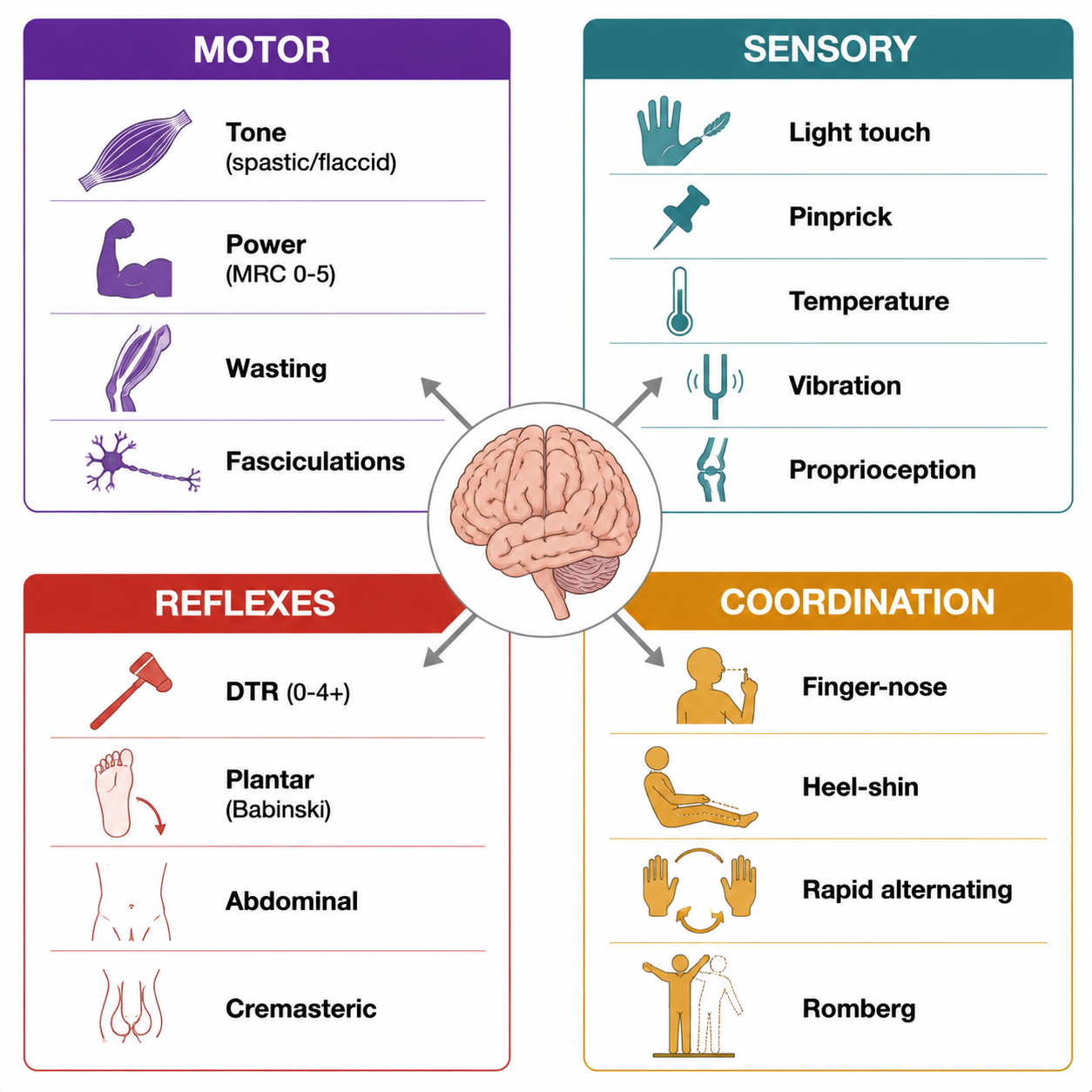
The neurological examination tests consciousness, cranial nerves, motor, sensory, reflexes, and coordination — with the goal of localizing the lesion (cortex, brainstem, spinal cord, peripheral nerve, neuromuscular junction). Master the GCS, the 12 cranial nerves, the UMN vs LMN distinction, the muscle power grading, the common reflexes (and their segmental levels), and the key procedures — especially lumbar puncture with its indications, contraindications, and CSF analysis.
Illustrations(图解速览)
Core Concepts — Conscious State & Higher Function
Consciousness exam
- Structured: general observation → verbal stimulation (name, simple commands) → painful stimulation (supraorbital pressure/sternal rub — eye opening, withdrawal, grimace)
- Glasgow Coma Scale (GCS): Eye (4) + Verbal (5) + Motor (6) = 3–15; coma = GCS ≤8 (light 6–8, deep 3–5)
- Fixed pupils + absent oculocephalic reflex = worse prognosis
- MMSE (30, <27 cognitive decline); MoCA (30, <26) — screen dementia
Nervous system organization
- CNS: brain (cerebrum, diencephalon, brainstem, cerebellum) + spinal cord
- PNS: cranial + spinal nerves
- Levels of consciousness: alert → lethargy → stupor → light coma → deep coma (+ confusion, delirium)
Core Concepts — Cranial Nerves (颅神经)
Mnemonic
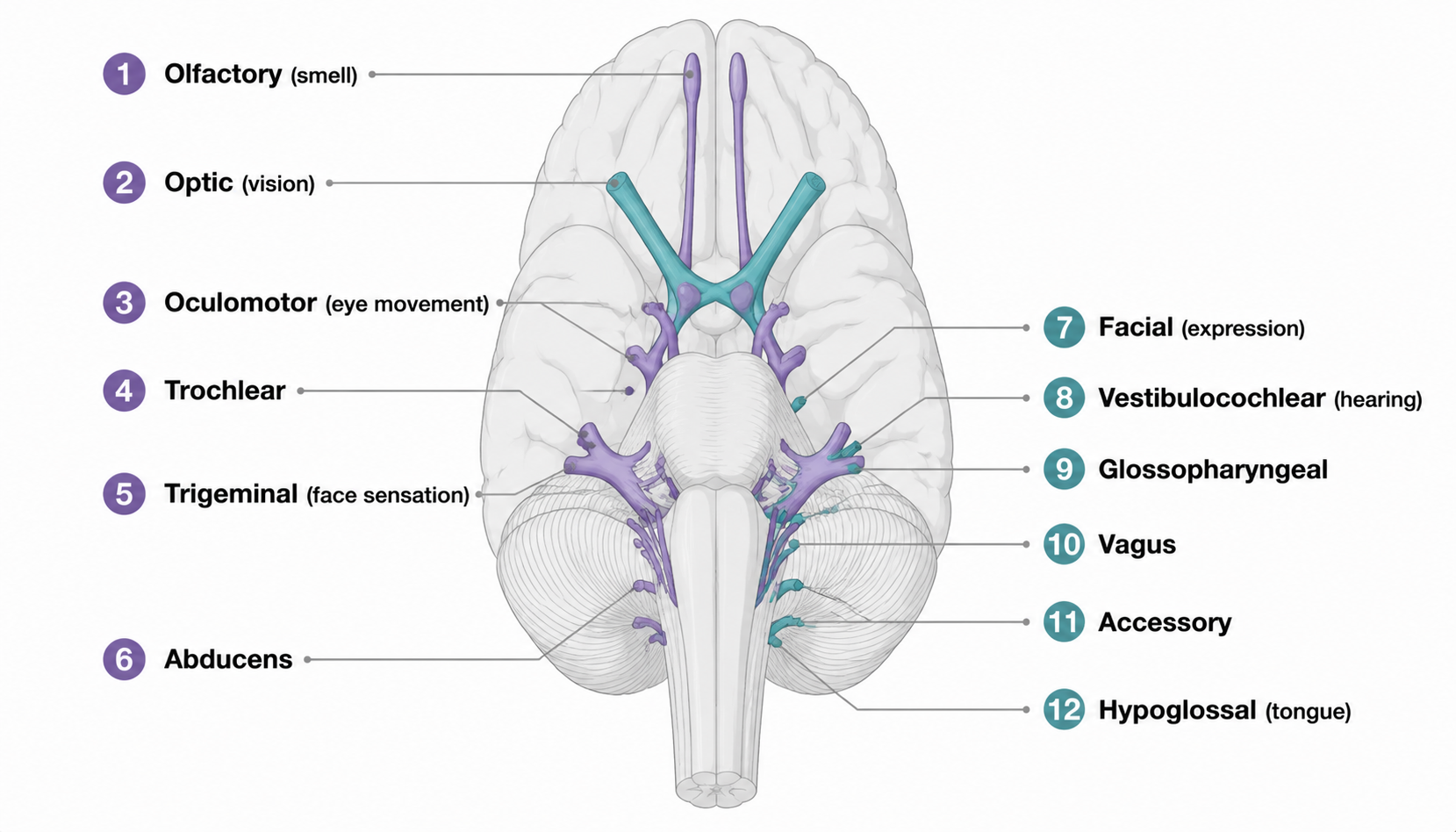
On Old Olympus's Towering Tops, A Finn And German Vended Some Hops = I Olfactory, II Optic, III Oculomotor, IV Trochlear, V Trigeminal, VI Abducens, VII Facial, VIII Vestibulocochlear, IX Glossopharyngeal, X Vagus, XI Spinal accessory, XII Hypoglossal
Functions — MUST KNOW
| CN | Name | Function |
|---|---|---|
| I | Olfactory | Smell (test one nostril at a time, non-irritating stimulus) |
| II | Optic | Vision, fields, fundus |
| III | Oculomotor | Eye movement (up/down/medial), pupil constriction, accommodation; ptosis |
| IV | Trochlear | Eye movement (down-in) |
| V | Trigeminal | Face sensation (3 divisions), chewing (masseter) |
| VI | Abducens | Eye abduction |
| VII | Facial | Face movement, taste (anterior 2/3), salivation, lacrimation |
| VIII | Vestibulocochlear | Hearing, balance |
| IX | Glossopharyngeal | Taste (posterior 1/3), swallowing, gag, carotid body/sinus |
| X | Vagus | Palate, swallowing, phonation, visceral |
| XI | Spinal accessory | Sternocleidomastoid, trapezius (turn head, shrug) |
| XII | Hypoglossal | Tongue movement (deviation toward lesion) |
- CN I, II: cerebrum (CNS); CN III–XII: brainstem — III, IV (midbrain), V–VIII (pons), IX–XII (medulla)
- Sensory: I, II, VIII; Motor: III, IV, VI, XI, XII; Mixed: V, VII, IX, X
Visual field defects (lesion localization)
- Central scotoma — optic disc/nerve inflammation
- Right monocular blindness — right optic nerve
- Bitemporal hemianopia — optic chiasm (pituitary)
- Right nasal hemianopia — perichiasmal lesion
- Right homonymous hemianopia — left optic tract
- Right homonymous superior quadrantanopia — left temporal lobe
- Right homonymous inferior quadrantanopia — left parietal lobe
Facial palsy — UMN vs LMN (HIGH YIELD)
| Feature | UMN (central) | LMN (peripheral) |
|---|---|---|
| Forehead | Spared (brow still moves) | Involved (whole half face) |
| Cause | Stroke, tumor (above nucleus) | Bell's palsy, Ramsay Hunt, acoustic neuroma |
| Other signs | Hemiparesis same side | Taste loss, hyperacusis (VII) |
| Mouth | Weak contralateral lower face | Weak entire side |
Core Concepts — Motor System
Muscle tone & power
- Tone: spasticity (UMN — clasp-knife), rigidity (extrapyramidal — lead pipe/cogwheel, Parkinson's), flaccidity (LMN), paratonia
- Power grading (0–5):
| Grade | Movement |
|---|---|
| 0 | No contraction |
| 1 | Flicker/trace |
| 2 | Movement with gravity eliminated |
| 3 | Movement against gravity |
| 4 | Movement against resistance (subgrade 4-/4/4+) |
| 5 | Normal power |
UMN vs LMN — MUST KNOW
| Feature | UMN lesion | LMN lesion |
|---|---|---|
| Muscle tone | Increased (spasticity) | Decreased (flaccidity) |
| Strength | Weak | Weak |
| Tendon reflexes | Hyperreflexia | Hyporeflexia/areflexia |
| Pyramidal signs | Babinski present | Absent |
| Muscle atrophy | Mild (disuse) | Significant, early |
| Fasciculations | Absent | Present |
Paralysis tests (subtle hemiparesis)
- Outstretched upper limb test (上肢平举): affected arm droops + pronates
- Barre finger separation test: affected fingers converge/flex
- Little finger sign (小指征): little finger abducts
- Lower limb dangling test (下肢下垂): paretic leg descends
- Jackson's sign (外旋征): paretic leg externally rotated
- Muscle circumference: difference >1 cm = abnormal
Core Concepts — Sensory System
- Modalities: light touch, pain (pinprick), temperature, vibration (128 Hz tuning fork), joint position (proprioception), two-point discrimination
- Patterns: peripheral nerve (single nerve territory), plexus, root (dermatome), cord (sensory level), brainstem (crossed/alternating), cortical (hemisensory)
- Dermatome reference: C5 shoulders, C6 thumb, C7 middle finger, C8 little finger, T4 nipple, T10 umbilicus, L4 knee, L5 big toe, S1 lateral foot
- Spinothalamic (pain/temp) vs dorsal column (vibration/proprioception) — dissociated loss in cord lesions
Core Concepts — Reflexes
Deep tendon reflexes & segmental levels
| Reflex | Segment | Response |
|---|---|---|
| Jaw jerk | V (CN V) | — |
| Biceps | C5–C6 | Flexion at elbow |
| Brachioradialis | C5–C6 | Elbow flexion |
| Triceps | C7 | Extension |
| Knee (patellar) | L2–L4 | Knee extension |
| Ankle (Achilles) | S1 | Plantar flexion |
- Grading: 0 absent, 1+ diminished, 2+ normal, 3+ brisk, 4+ hyperactive (clonus)
- Babinski sign: stroke lateral plantar → big toe up + fanning = UMN lesion (normal = plantar flexion in adults)
- Superficial: abdominal (T7–T12), cremasteric (L1–L2), anal (S3–S5)
- Clonus (sustained beats) = UMN
Core Concepts — Coordination & Gait
- Finger-nose, heel-shin tests: dysmetria = cerebellar lesion (same side)
- Rapid alternating movements: dysdiadochokinesia
- Romberg test: sway on closing eyes = sensory ataxia (dorsal column) (18CM exam tested); sway with eyes open = cerebellar
- Gait: hemiplegic (circumducting), ataxic (wide-based), waddling (proximal myopathy/DMD), high-steppage (foot drop — peroneal/L5), Parkinsonian (festinating), apraxic
Core Concepts — Lumbar Puncture (腰椎穿刺术)
Indications
- Diagnostic: suspected SAH (CT normal), CNS infection (meningitis/encephalitis), autoimmune CNS inflammation (autoimmune encephalitis, MS, GBS, myelitis), intracranial hypotension/IIH, leptomeningeal metastases
- Therapeutic: reduce ICP (IIH, hydrocephalus), intrathecal drugs (anesthesia, chemotherapy)
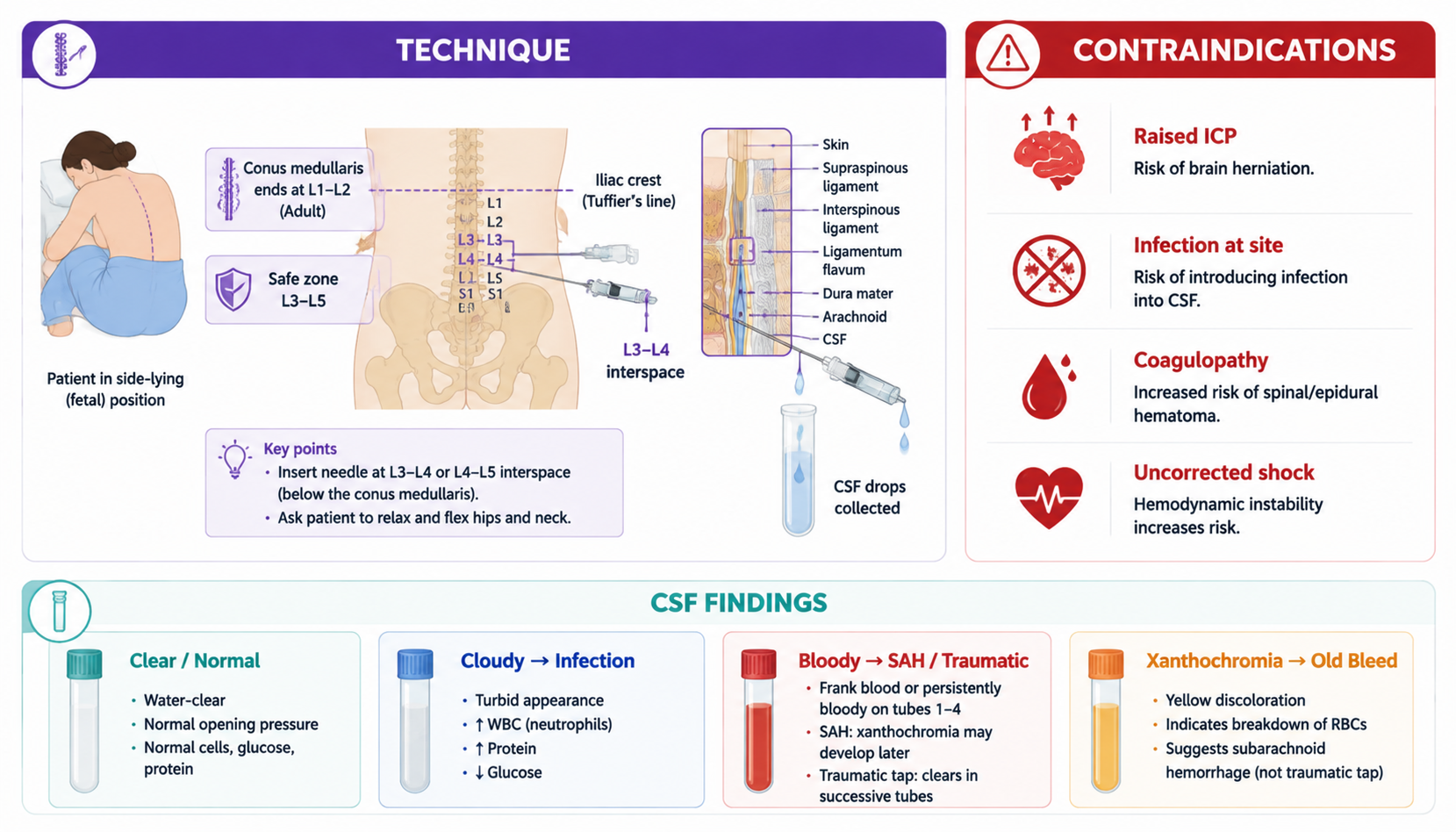
Contraindications — MUST KNOW
- Signs of brain herniation (papilledema, pupillary changes, acutely worsening consciousness)
- Suspected posterior fossa tumor
- Infection at puncture site
- Bleeding tendency (platelet <50×10⁹/L) — anticoagulants
- Acute spinal cord trauma; critical illness/sepsis
Preparation & positioning
- Personnel: examiner + assistant; informed consent; wash hands, mask/cap
- Equipment: LP bag (manometer, spinal needle with stylet, tubes), sterile gloves, antiseptic, 2% lidocaine, cotton swabs, tape
- Position: lateral decubitus, curled (knees to abdomen, neck flexed), back perpendicular to bed, lumbar close to bed edge; or sitting
- Site: L3-4 or L4-5 interspace (line between posterior iliac crests)
Procedure
- Sterilize skin (iodine, 3×, 15 cm diameter)
- Gloves + fenestrated drape; local anesthesia (lidocaine)
- Insert needle through interspace (skin → subcutaneous → supraspinous → interspinous → ligamentum flavum → epidural → dura → arachnoid → subarachnoid; ~4–6 cm deep), stylet withdrawn → clear/straw CSF drips
- Measure ICP with manometer: normal 80–180 mmH2O (adult), 40–100 (child); >200 = raised; <80 = low
- Queckenstedt test: compress jugulars → normal rise = canal patent; no rise = spinal block (compression of abdomen doesn't test thoracic/cervical)
- Collect 2–3 ml (10–15 drops) in 3–4 tubes
- Withdraw with stylet, sterile dressing; patient flat without pillow 4–6 hours
Complications & management
- Post-spinal headache (20–70%): bed rest with foot elevated 15–20°, IV 1000 ml 0.9% NaCl, caffeine
- Nerve root pain/dysesthesia: rest, physiotherapy, analgesia
- Brain herniation (emergency): inject air/saline, rapid IV mannitol 250 ml, ventriculostomy
- Infection, hemorrhage
- Attention: prep mannitol if raised ICP suspected; intrathecal injection slowly over 10 min (dilute with CSF); vital sign monitoring
CSF analysis — HIGH YIELD
| Parameter | Normal | Abnormal |
|---|---|---|
| Appearance | Clear, colorless | Turbid (pyogenic), bloody (SAH), xanthochromic (old blood), cloudy |
| Pressure | 80–180 mmH2O | ↑ (meningitis, tumor, IIH); ↓ (leak) |
| WBC | <5/mm³ (lymphocytes) | ↑ ↑PMN = bacterial; ↑lymphocytes = TB/viral |
| Protein | 0.15–0.45 g/L | ↑ (infection, tumor, GBS — albuminocytologic dissociation) |
| Glucose | 2/3 of serum | Low = bacterial/TB/fungal meningitis; normal = viral |
| Other | — | Gram stain, culture, ADA (TB), oligoclonal bands (MS), cytology (malignancy) |
- Bacterial meningitis: turbid, ↑PMN, ↓glucose, ↑protein, Gram+/culture+
- TB meningitis: ↑lymphocytes, ↓glucose, ADA >6–8 U/L, low-volume xanthochromic
- Viral: ↑lymphocytes, normal glucose
- SAH: bloody, xanthochromic supernatant (after centrifuge), ↑RBC
High-Yield Points
- GCS ≤8 = coma; E4V5M6 = 15
- UMN: spasticity + hyperreflexia + Babinski + no fasciculations; LMN: flaccid + hyporeflexia + atrophy + fasciculations
- CN mnemonic: On Old Olympus's Towering Tops, A Finn And German Vended Some Hops
- Facial palsy: forehead spared = UMN (central); whole face = LMN (Bell's)
- Bitemporal hemianopia = chiasm (pituitary); homonymous = retrochiasmal (optic tract/radiation)
- Reflex levels: biceps C5-6, triceps C7, knee L2-4, ankle S1
- Babinski upgoing toe = UMN; clonus = UMN
- LP contraindications: papilledema/herniation, posterior fossa tumor, site infection, platelets <50k, anticoagulation
- LP site L3-4/L4-5; normal pressure 80–180 mmH2O; post-LP headache → lie flat 4–6 h
- CSF: ↓glucose + ↑PMN = bacterial; ↓glucose + lymphocytes = TB; normal glucose + lymphocytes = viral
- Power grading 0–5 with precise anchors
LMCHK OSCE Practice
- Neurology short case (8 min, Station 2): chronic neuro cases — poliomyelitis, Charcot-Marie-Tooth, neuromuscular junction disease; aim to find the location of lesion
- Sequence: consent/hand hygiene → general inspection (posture, gait, tremor) → higher functions → cranial nerves (I–XII systematically) → motor (tone, power, pronator drift) → reflexes (with grading) → sensory → coordination (finger-nose, heel-shin, Romberg) → gait → comment on lesion localization
- Cranial nerve exam must be fluent: pupils (PERRLA) → fields → fundi → EOM (H-pattern) → face sensation + masseter → facial movements (forehead vs lower face!) → hearing + Weber/Rinne → palate/gag → tongue/shoulders
- Comment: "This patient has UMN signs (spasticity, hyperreflexia, upgoing plantar) affecting the right side — consistent with a left-sided upper motor neuron lesion"
- Fundoscopy always offered; state what you'd check (papilledema before LP)
Topic Summary
Neuro exam = consciousness (GCS) → cranial nerves (12, with UMN/LMN facial distinction and visual field localization) → motor (tone, power 0-5, UMN vs LMN) → sensory (spinothalamic vs dorsal column) → reflexes (segmental levels, Babinski) → coordination (finger-nose, Romberg) → gait. Lumbar puncture: diagnostic/therapeutic indications, strict contraindications (herniation, low platelets), L3-4 positioning, ICP 80-180 mmH2O, Queckenstedt test, CSF interpretation (bacterial = ↓glucose ↑PMN; TB = ↓glucose ↑lymph; viral = normal glucose). Always localize the lesion — that's the clinical and OSCE goal.