Preparatory Mindset
Laboratory diagnostics (实验诊断) turns patient samples (blood, urine, CSF, effusions, bone marrow) into objective data that reflects functional status and etiologic hints. Master the testing cycle (selection → patient preparation → collection → processing → analysis → reporting → clinical decision), the factors that distort results (biological, collection, analytical), and the reference-interval concept. This chapter covers the general principles + the blood/urine basics; the detailed systems (biochemistry, immunology, coagulation, renal) are in their own chapters.
Illustrations(图解速览)
Core Concepts — Principles of Clinical Laboratory
Definition
- Experimental diagnosis: examining samples from blood, body fluids, secretions, excreta, tissues, and cells using laboratory methods to obtain data reflecting the body's functional status, pathological changes, and etiological hints
- Laboratory medicine: analytical tests on human body substances to detect/prevent disease and monitor health
Testing cycle (检验流程)
- Test selection (clinical question)
- Patient preparation for sampling
- Specimen collection (informed consent, adequate privacy)
- Pre-processing
- Analysis
- Check and report result
- Clinical decision
Factors affecting tests — MUST KNOW
| Category | Examples |
|---|---|
| Sex | Sex hormones |
| Body mass | Triglycerides |
| Biological rhythms | Cortisol, blood cells, menstrual cycle (circadian <24h, ultradian, infradian) |
| Stress | Cortisol, glucose |
| Posture | Renin, aldosterone |
| Exercise | Muscle enzymes, lactate |
| Diet | Glucose, triglycerides (fasting ≥8 h for glucose, TG, cholesterol, LDL, BUN) |
| Drugs | Many |
Specimen collection
- Sites: capillary (infants/small volume), vein (most biochemical tests), artery (blood gas — radial/brachial/femoral)
- Time: morning fasting (空腹, ≥8 h no eating), postprandial, specific time point, emergency (any time)
- Vacutainers — anticoagulants by test:
| Tube | Use |
|---|---|
| Sodium citrate (blue) | Coagulation tests |
| EDTA-K2 (purple) | CBC / peripheral blood smear |
| Heparin (green) | RBC osmotic fragility, blood gas |
| Plain (red) | Serum biochemistry |
- Serum vs plasma: serum = plasma minus fibrinogen (after clotting); interchangeable for most biochemical tests
- Hemolyzed / lipemic / icteric samples distort results — reject or note
Reference intervals & variability
- Biological variation: within-subject + between-subject → reference interval (RI) width determines diagnostic efficiency
- Minimize variability: standard patient prep, correct collection, calibrated analysis, appropriate RI
Core Concepts — Complete Blood Count (血常规)
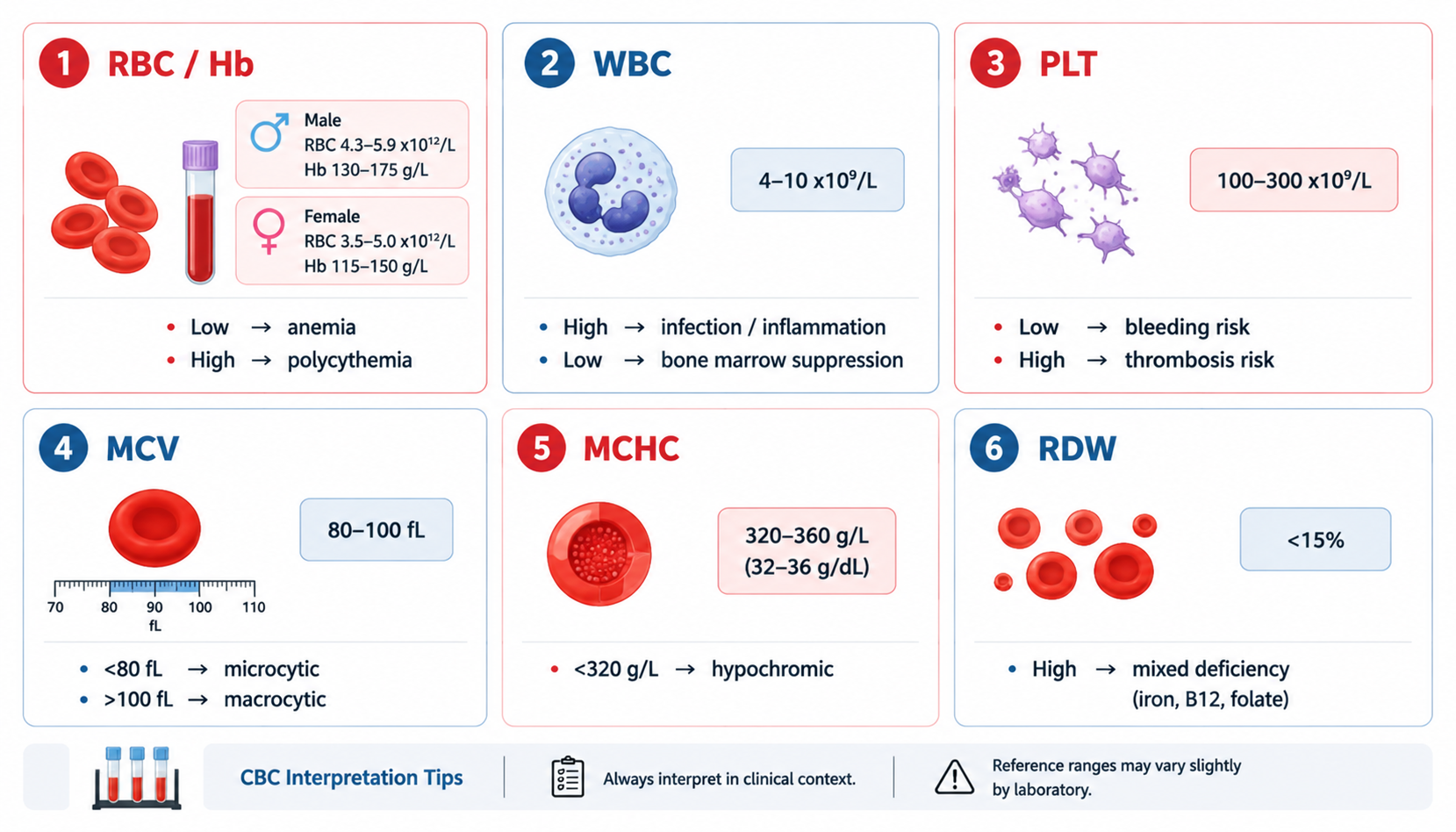
Reference values — MUST KNOW
| Parameter | Male | Female | Notes |
|---|---|---|---|
| RBC | 4.0–5.5 ×10¹²/L | 3.5–5.0 ×10¹²/L | Infants 6.0–7.0 |
| Hb | 120–160 g/L | 110–150 g/L | Infants 170–200 |
| WBC | 4–10 ×10⁹/L | same | — |
| Platelets | 100–300 ×10⁹/L | same | Life 7 days |
| Reticulocytes | 0.5–1.5% | same | RBC life 120 days |
RBC abnormalities
- Anemia degree: mild (Hb >90), moderate (60–90), severe (<60), critical (<30)
- Spherocyte (hereditary spherocytosis), target cell (thalassemia), sickle (HbS), tear-drop (myelofibrosis/hemolytic), schistocyte (DIC/microangiopathic), burr/spur (splenectomy, liver disease, uremia), rouleaux (multiple myeloma)
- Number ↑: relative (hemoconcentration — vomiting, diarrhea, sweating, burns); absolute (polycythemia: secondary EPO ↑ — high altitude, lung/heart disease, tumors; polycythemia vera)
- Number ↓: anemia — Hb <120 (M), <110 (F)
- Morphology: macrocyte (>10 μm), microcyte (<6 μm), megalocyte (>15 μm)
- MCV classification: microcytic (IDA, thalassemia, sideroblastic), normocytic (anemia of chronic disease, hemolysis, acute loss), macrocytic (B12/folate deficiency, MDS, alcohol, liver)
WBC abnormalities — HIGH YIELD
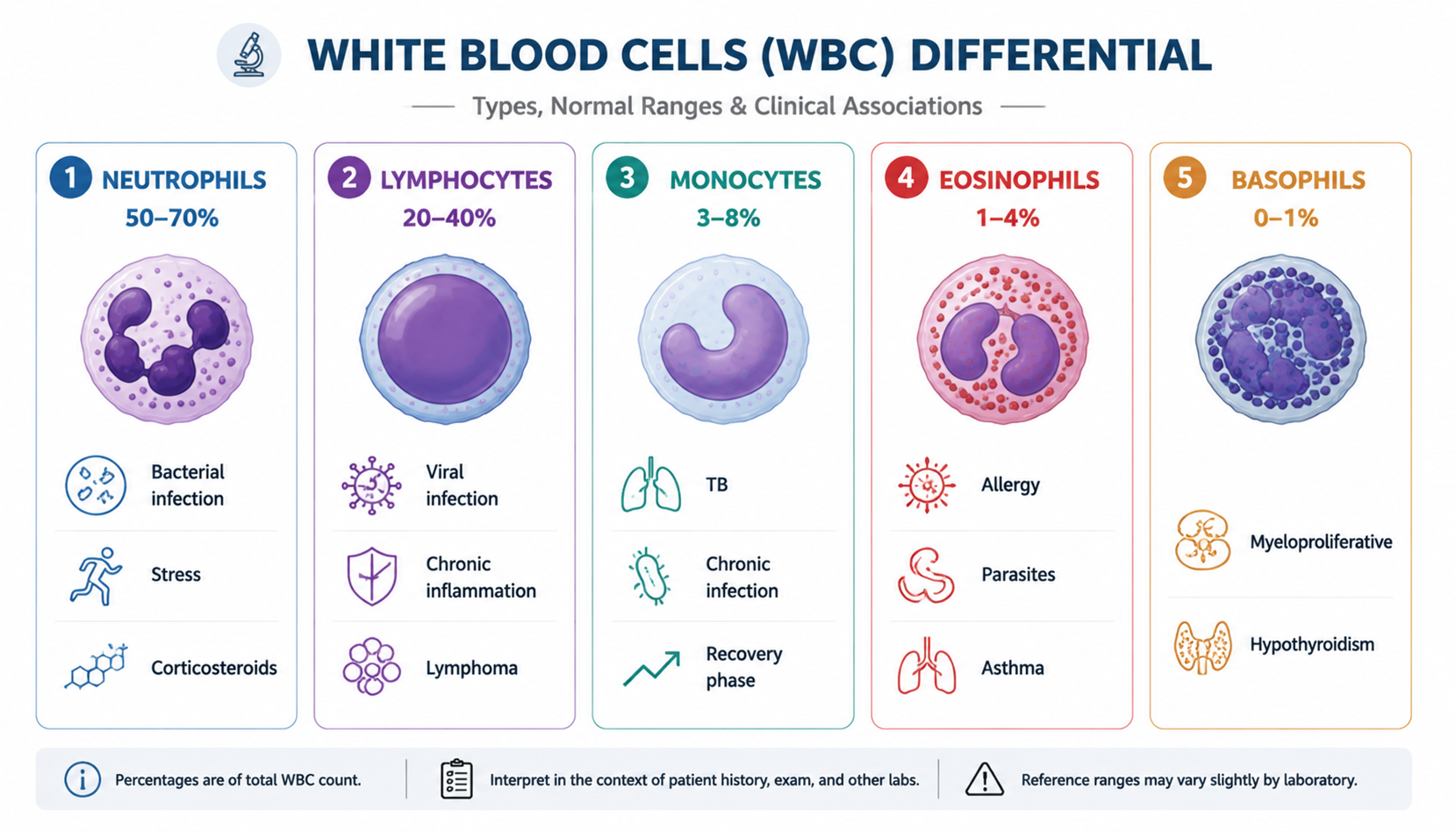
- Neutrophil ↑: bacterial infection (most common cause), inflammation, tissue necrosis, stress, corticosteroids, leukemia (CML), leukemoid reaction (>50 ×10⁹/L, non-leukemic)
- Neutrophil ↓: viral infection, typhoid, aplastic anemia, chemotherapy/radiation, drugs, SLE, hypersplenism
- "Shift to the left" (核左移): more immature neutrophils (bands) — acute bacterial infection, inflammation (18CM exam tested); severe shift with myelocytes/metamyelocytes
- "Shift to the right" (核右移): hypersegmented neutrophils — megaloblastic anemia (B12/folate), liver disease
- Eosinophil ↑: allergy/asthma, parasitic infection, drug reaction, Churg-Strauss
- Lymphocyte ↑: viral infection (mononucleosis), pertussis, TB, CLL; ↓: immunocompromised
- Monocyte ↑: TB, mononucleosis, recovery phase of infection
- Auer bodies (Auer rods): seen in AML blasts — diagnostic clue
- Leukemoid reaction: marked WBC ↑ (>50 ×10⁹/L) with left shift in response to severe infection/hemorrhage/malignancy — NOT leukemia (leukocyte alkaline phosphatase normal/high vs low in CML)
Anemia overview
- Hemorrhagic (acute/chronic), hemolytic (hereditary — spherocytosis, G6PD, thalassemia, sickle (18CM exam tested); acquired — autoimmune, PNH, DIC), deficient (iron, B12, folate), aplastic, secondary (renal — EPO ↓, chronic disease)
- Coombs test (DAT): autoimmune hemolytic anemia (warm antibody IgG)
- Ham's test / CD55, CD59 (PNH clone): paroxysmal nocturnal hemoglobinuria
- Reticulocyte: ↑ = bone marrow response (hemolysis, acute blood loss, response to iron/B12 therapy); ↓ = marrow failure (aplastic, deficiency)
ESR (血沉, erythrocyte sedimentation rate)
- Normal: male 0–15 mm/h, female 0–20 mm/h
- ↑: infection, inflammation (TB, rheumatic fever, RA), malignancy, tissue necrosis, anemia, pregnancy
- Useful for monitoring TB/rheumatic disease; non-specific
Core Concepts — Common Samples & Tests
- Blood: CBC, biochemistry, immunology, culture
- Urine: routine (physical/chemical/microscopic) — see urinalysis chapter
- Stool: occult blood, culture, ova/parasites
- CSF: meningitis/SAH workup (see LP chapter)
- Effusions: transudate vs exudate (see serous membrane chapter)
- Bone marrow: leukemia/MICM (see bleeding/bone marrow chapter)
- Sputum: culture, AFB (TB), cytology
High-Yield Points
- Testing cycle: selection → preparation → collection → processing → analysis → report → decision
- Fasting ≥8 h for glucose, TG, cholesterol, LDL, BUN
- Anticoagulant map: citrate = coagulation; EDTA = CBC; heparin = osmotic fragility/gas
- Serum = plasma − fibrinogen
- Normal: Hb 120–160 M / 110–150 F; WBC 4–10; Plt 100–300; RBC life 120 d, Plt 7 d, WBC 7 h
- Neutrophilia = bacterial; lymphocytosis = viral; eosinophilia = allergy/parasites
- Shift to the left = acute bacterial infection; Auer bodies = AML; rouleaux = multiple myeloma
- Leukemoid reaction vs CML: WBC >50, LAP normal/high vs low, Philadelphia chromosome
- Reticulocyte ↑ = marrow response (hemolysis/bleeding); ↓ = marrow failure
- Hemolyzed/lipemic/icteric samples invalidate results
- Coombs (AIHA), Ham's + CD55/59 (PNH)
LMCHK OSCE Practice
- CBC interpretation in OSCE: pattern recognition — microcytic anemia (↓MCV: iron deficiency/thalassemia), macrocytic (↑MCV: B12/folate), leukocytosis with left shift (infection), blasts (leukemia — urgent referral)
- Comment on blood film: target cells (thalassemia), schistocytes (DIC/TTP), rouleaux (myeloma), sickle cells
- "This patient has microcytic hypochromic anemia — I would check iron studies, ferritin, and consider thalassemia"
- Interpretation approach: Hb → RBC indices (MCV/MCH/MCHC) → WBC (count + differential) → platelets → film
- Never miss: blasts on film (acute leukemia), schistocytes (TTP/DIC emergency), severe thrombocytopenia (<20k — bleeding risk)
Topic Summary
Laboratory diagnostics: follow the testing cycle and control pre-analytical variables (fasting, rhythms, posture, drugs, anticoagulant choice). CBC: know reference ranges (Hb, WBC, Plt), RBC morphology (spherocytes, target, sickle, schistocytes), WBC differential patterns (bacterial vs viral, left shift, Auer bodies, leukemoid reaction), anemia classification by MCV, reticulocyte response, and ESR. Connect every lab value back to a mechanism and a clinical question — that is the core of experimental diagnosis.