Preparatory Mindset
Urinalysis and renal function tests are the front line for detecting kidney disease, UTI, diabetes, and metabolic disorders. Urinalysis = physical + chemical + microscopic examination of urine; renal function = glomerular (Cr, BUN, eGFR, clearance) and tubular (concentrating ability, RTA) tests. Master the specimen types, the normal values, the interpretation of proteinuria/hematuria/casts, and the AKI vs CKD approach (18CM & 19CM exam tested). The classic exam pair: creatinine (filtration) vs urea (protein catabolism + filtration).
Illustrations(图解速览)
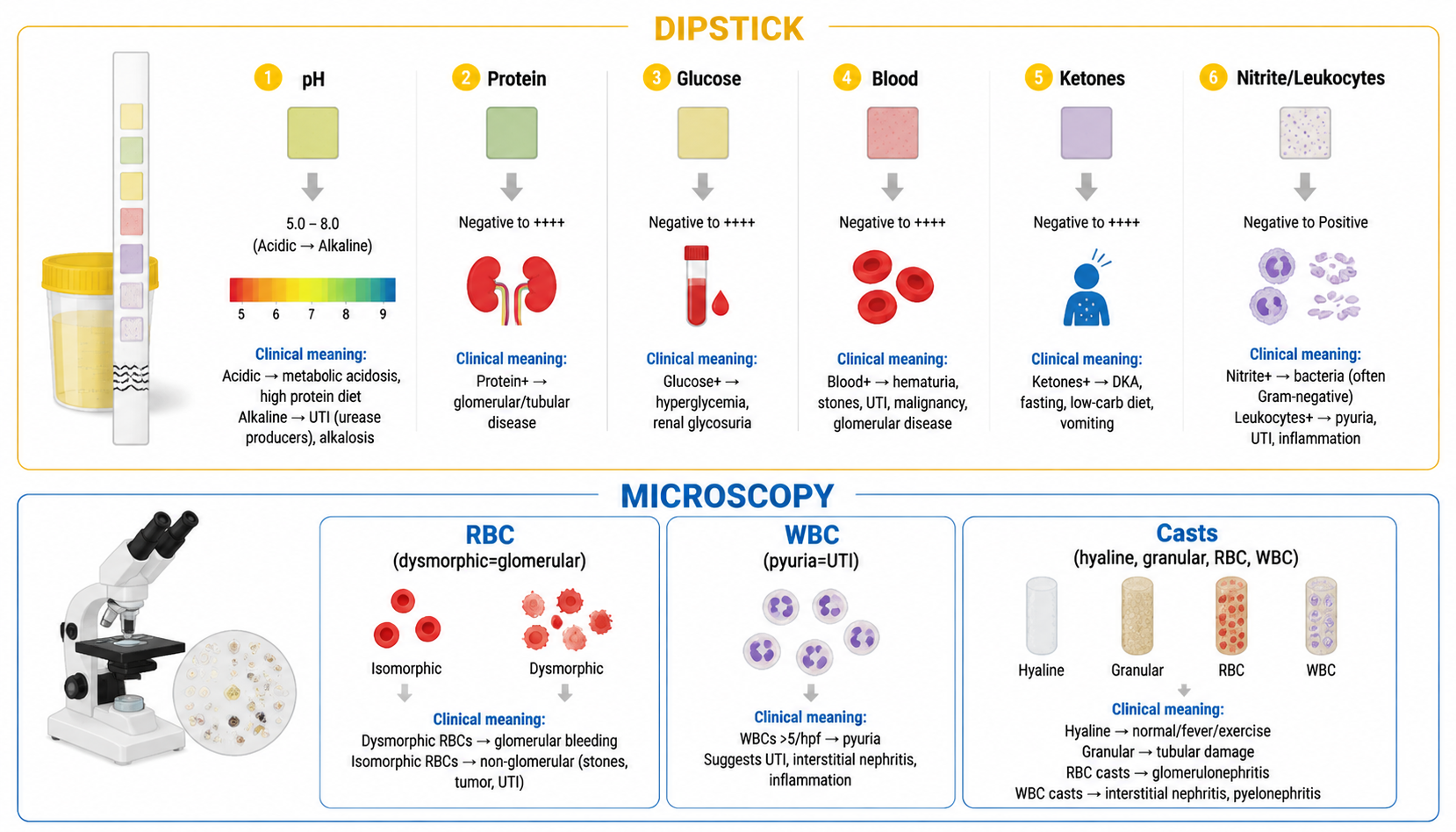
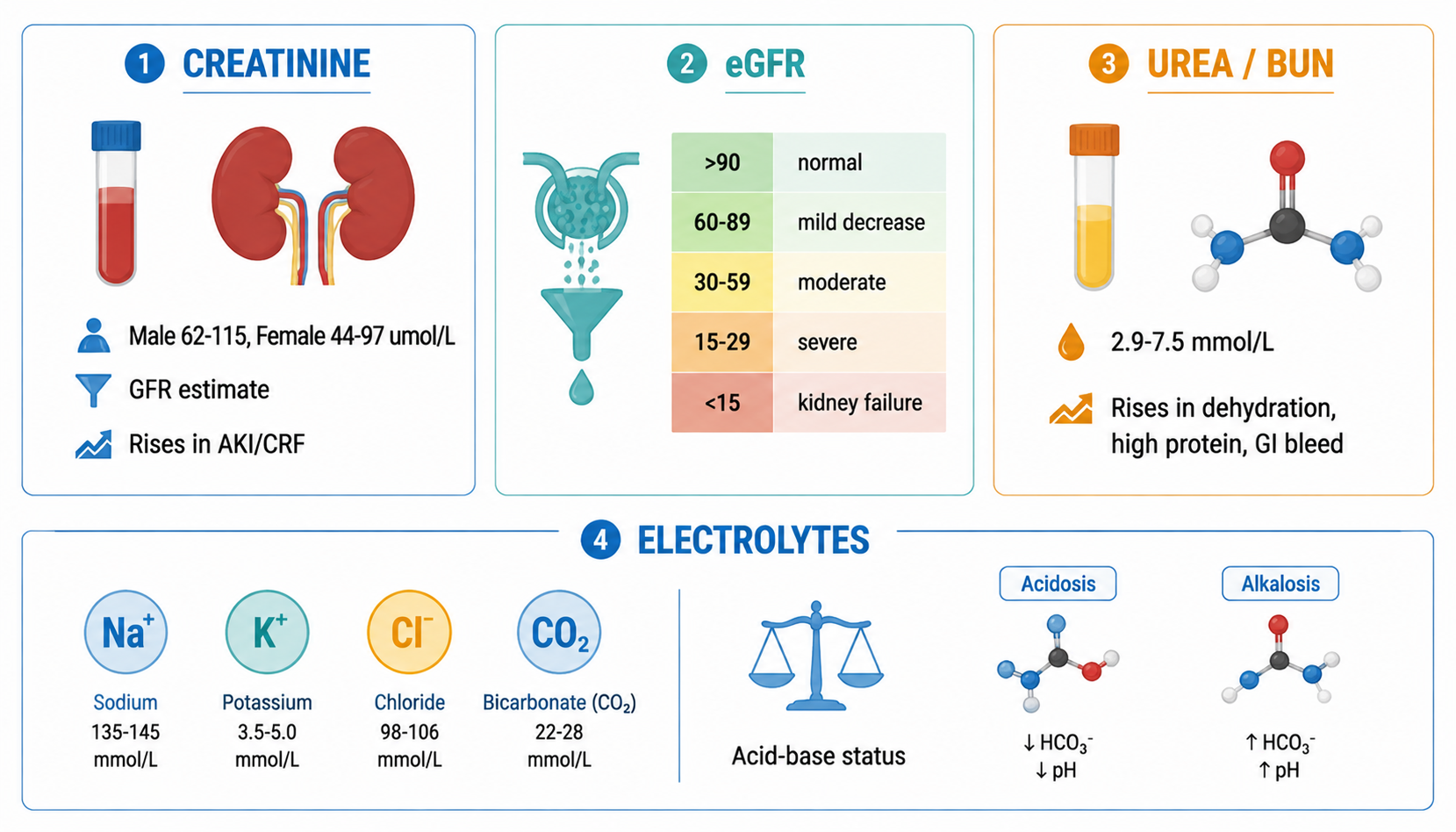
Core Concepts — Urinalysis (尿常规)
Purpose & specimen types
- Purposes: general health evaluation; diagnosis of metabolic/systemic/endocrine disease; kidney/urinary tract disease; diabetes monitoring; drug screening
- Types:
| Type | Use |
|---|
| Random | Routine screening |
| First morning | Concentrated — qualitative, microalbuminuria detection |
| Midstream (MSU, clean catch) | Urine culture (UTI) |
| 24-hour | Quantitative (protein, creatinine clearance) |
| Postprandial | Glucose monitoring (2h post-meal) |
Physical examination
| Component | Normal | Abnormal |
|---|
| Volume | 1000–2000 ml/24h | Polyuria >2500; oliguria <400 (<17 ml/h); anuria <100 |
| Color | Clear, pale yellow | Colorless (dilution, DM, DI, diuretics); milky (pyuria, chyluria); orange (fever, dehydration); red (hematuria, beetroot); brown/black (alkaptonuria, melanin) |
| pH | 4.5–8.0 | Acidic: high-protein diet, acidosis, DKA, diarrhea, starvation; Alkaline: UTI obstruction, vegetarian, pyloric obstruction, RTA, chronic renal failure |
| Specific gravity | 1.015–1.025 | High >1.025: dehydration, ADH↑; Low <1.015: polyuria causes, DI, GN/pyelonephritis; Fixed 1.007–1.010 (isosthenuria) = chronic renal failure (lost concentration) |
| Odor | Aromatic | Ammonia (bacterial action); fruity (ketonuria) |
Chemical examination
| Test | Normal | Abnormal → think |
|---|
| Protein | Negative | Proteinuria (see below) |
| Glucose | Negative | Glycosuria: DM, renal glycosuria, stress |
| Ketones | Negative | DKA, starvation, fasting, vomiting |
| Bilirubin | Negative | Obstructive/hepatocellular jaundice (conjugated) |
| Urobilinogen | Trace | ↑ hemolysis, hepatocellular; absent in complete obstruction |
| Blood (RBC) | Negative | Hematuria: GN, stones, tumor, infection, trauma |
Proteinuria — HIGH YIELD
- Normal: <150 mg/day (or <10 mg/100 ml); albumin mostly
- Microalbuminuria: 30–300 mg/day — early diabetic nephropathy marker (first morning specimen)
- Clinical proteinuria: >300 mg/day or "++"
- Mechanisms: glomerular (nephrotic >3.5 g/day — albumin), tubular (small proteins — light chains), overflow (myeloma Bence-Jones protein), functional/orthostatic (transient, young, after exercise/fever/standing)
- Nephrotic syndrome: proteinuria >3.5 g/day + hypoalbuminemia + edema + hyperlipidemia
- Urine dipstick: + = 300 mg/L (semiquantitative); albumin-sensitive, misses globulins
Microscopic examination
| Element | Normal | Abnormal → think |
|---|
| RBC | <3/HPF | Hematuria: glomerular (dysmorphic, casts) vs urologic |
| WBC | <5/HPF | Pyuria: UTI, pyelonephritis, TB, interstitial nephritis |
| Casts | Hyaline occasional | RBC casts = glomerulonephritis (pathognomonic); WBC casts = pyelonephritis; granular/waxy = renal disease; fatty = nephrotic |
| Crystals | Variable | Uric acid (gout), calcium oxalate (stones), triple phosphate (infection) |
| Bacteria | None | UTI (confirm culture) |
| Cells | Few epithelial | Tubular cells = ATN; malignant cells = urothelial cancer |
- Dysmorphic RBC + RBC casts + proteinuria = glomerular bleeding (nephritis)
- Casts are formed in renal tubules — their presence localizes disease to the kidney
- Chyluria: milky urine — filariasis (lymphatic obstruction)
Core Concepts — Renal Function Tests (肾功能检查)
Glomerular filtration — the core
- GFR = rate (ml/min) at which plasma is filtered through the glomerulus — best single measure of kidney function
- Plasma renal flow ~600 ml/min/1.73 m²; ultrafiltration ~180 L/day; >99% reabsorbed
- Ideal marker: produced endogenously at constant rate, freely filtered, not reabsorbed/secreted/metabolized
| Marker | Filtered? | Reabsorbed? | Secreted? | Notes |
|---|
| Inulin | Yes | No | No | Gold standard (exogenous, must infuse — research only) |
| Creatinine | Yes | Slight | ~10% secreted | Endogenous, near-constant production from muscle; standard clinical estimate |
| Urea (BUN) | Yes | Partially | No | Protein catabolism; varies with diet; less reliable |
| Cystatin C | Yes | Completely | No | Better at borderline GFR |
- Serum creatinine vs GFR: GFR is proportional to 1/[Cr]; Cr doubles → GFR halves (roughly)
- Cr normal: 44–133 µmol/L (0.6–1.2 mg/dL); affected by muscle mass (body builders high, amputees/vegetarians low), age, sex
Creatinine clearance (Ccr)
- Ccr = (UCr × V) / SCr (urine volume/time) — normal 80–120 ml/min/1.73 m²
- Decreased: acute GN, ↓renal blood flow (shock, hemorrhage, dehydration, CHF), acute/chronic renal failure, nephrotoxic drugs
- Increased: high cardiac output, exercise, infection, hypothyroidism
- Limitations: steady state only; trimethoprim/cimetidine lower tubular secretion (Ccr ↓ without GFR change); inaccurate at low GFR; timed-urine collection errors
eGFR & CKD staging (KDOQI)
| Stage | GFR (ml/min/1.73m²) | Description |
|---|
| 1 | ≥90 | Normal or high + kidney damage (proteinuria) |
| 2 | 60–89 | Mild ↓ + kidney damage |
| 3a/3b | 45–59 / 30–44 | Moderate ↓ |
| 4 | 15–29 | Severe ↓ |
| 5 | <15 | Kidney failure (dialysis/transplant) |
- AKI: rapid rise in Cr (≥26.5 µmol/L in 48h or ≥1.5× baseline) — prerenal/renal/postrenal
Blood urea nitrogen (BUN)
- BUN = product of protein catabolism, synthesized by liver, excreted by kidney, partially reabsorbed
- ↑ with ↓GFR; also ↑ in GI bleeding (blood protein), high-protein diet, dehydration, catabolism, corticosteroids
- BUN/Cr ratio: >20:1 = prerenal (dehydration, GI bleed, heart failure); <10–15:1 = renal (ATN) or low intake
- BUN alone is a poor GFR marker (diet-dependent) but useful with Cr
Tubular function tests
- Concentrating/diluting ability: urine SG/osmolality after water deprivation — loss of concentration (fixed SG ~1.010) = tubular damage (chronic renal failure, diabetes insipidus)
- Urine osmolality >800 mOsm/kg = good concentration; <300 = DI/renal failure
- Renal tubular acidosis (RTA): hyperchloremic metabolic acidosis with normal anion gap; types I (distal — hypokalemia, stones), II (proximal — bicarbonate wasting), IV (hypoaldosteronism — hyperkalemia)
- β2-microglobulin, NAG: tubular proteinuria/enzymuria — proximal tubular injury
Case: interpreting renal panel
| Test | Result | Interpretation |
|---|
| SCr | ↑↑ (e.g. 400 µmol/L) | ↓GFR |
| BUN | ↑↑ with BUN/Cr >20 | Prerenal component (dehydration, bleeding, HF) |
| BUN/Cr <10 | Intrinsic renal (ATN, GN) |
| K+ | ↑ | Renal failure, tumor lysis, acidosis |
| Ca/P | ↓Ca ↑P | Chronic renal failure (secondary hyperparathyroidism) |
| Urine | RBC casts + protein | Glomerulonephritis |
| WBC casts | Pyelonephritis |
| Bland sediment | Prerenal/ATN (muddy brown casts in ATN) |
| Ultrasound | Small kidneys | CKD; large kidneys = polycystic, DM, amyloid |
High-Yield Points
- Urine volume: polyuria >2500; oliguria <400; anuria <100 ml/24h
- SG fixed ~1.010 = chronic renal failure (isosthenuria)
- Microalbuminuria 30–300 mg/day = early diabetic nephropathy; >300 mg/day = clinical proteinuria; >3.5 g/day = nephrotic range
- RBC casts = glomerulonephritis (pathognomonic); WBC casts = pyelonephritis; muddy brown granular casts = ATN
- Dysmorphic RBC + proteinuria + casts = glomerular bleeding
- Inulin = gold standard GFR; creatinine = clinical standard (10% secreted); cystatin C better at borderline
- Ccr normal 80–120 ml/min/1.73m²
- BUN/Cr >20 = prerenal; <10 = intrinsic renal
- CKD stages by GFR; stage 5 = renal replacement
- Chyluria (filariasis), fruity urine (DKA), alkaline urine (RTA, obstruction)
LMCHK OSCE Practice
- Urinalysis interpretation: given dipstick + microscopy → comment on protein, blood, glucose, WBC, casts; state what further tests (culture, 24h protein, renal USS, ANA/complement if nephritis)
- AKI workup: history (dehydration, drugs, contrast, obstruction), exam (JVP, edema), urine (SG, casts, dipstick), US kidneys, BUN/Cr ratio, check K+
- CKD: diagnose + stage (eGFR), screen complications (anemia — EPO, renal bone disease, acidosis, hyperkalemia), BP control (ACEi/ARB), refer nephrology at stage 4
- Proteinuria: quantify (24h or ACR/PCR on spot urine), classify (nephrotic vs nephritic)
- Nephrotic syndrome (LMCHK paeds case): generalized oedema + proteinuria → steroid therapy
- Diabetic nephropathy: annual microalbuminuria screening — ACEi/ARB protective
Topic Summary
Urinalysis: physical (volume/color/pH/SG), chemical (protein/glucose/ketones/bilirubin/blood), microscopic (RBC/WBC/casts/crystals). Proteinuria ladder: <150 normal → 30–300 microalbuminuria (diabetic nephropathy) → >300 clinical → >3.5 g nephrotic. Casts localize to kidney (RBC casts = GN). Renal function: GFR via creatinine (inverse), Ccr 80–120, eGFR for CKD staging, BUN as adjunct (BUN/Cr ratio prerenal vs renal), tubular tests (SG, RTA). Interpret AKI (prerenal/renal/postrenal) and CKD (stage + complications) systematically.