Preparatory Mindset
Clinical immunology & biochemistry are the "chemical eyes" of the lab. Immunology centers on antigen-antibody interaction (the "core") with the three elements (antigen, antibody, immune cell) and the four labeling technologies (enzyme, radioimmunoassay, fluorescence, chemiluminescence). Biochemistry provides the metabolic profile — glucose, lipids, proteins, enzymes, electrolytes — with cardiac markers (troponin, CK-MB, myoglobin) as the emergency centerpiece. Learn the marker's "what it is, when it rises, when it peaks, when it normalizes" timeline.
Illustrations(图解速览)
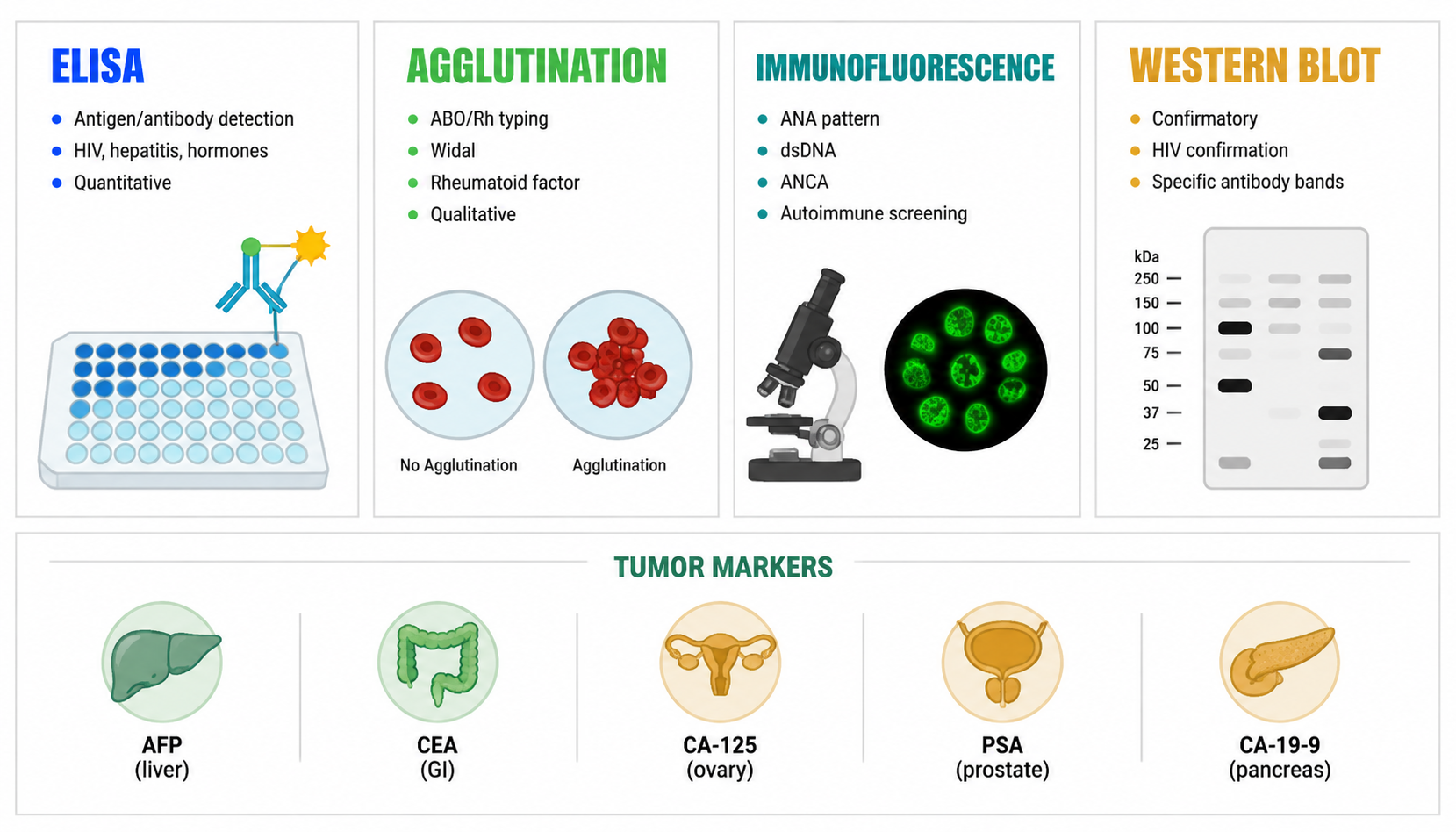
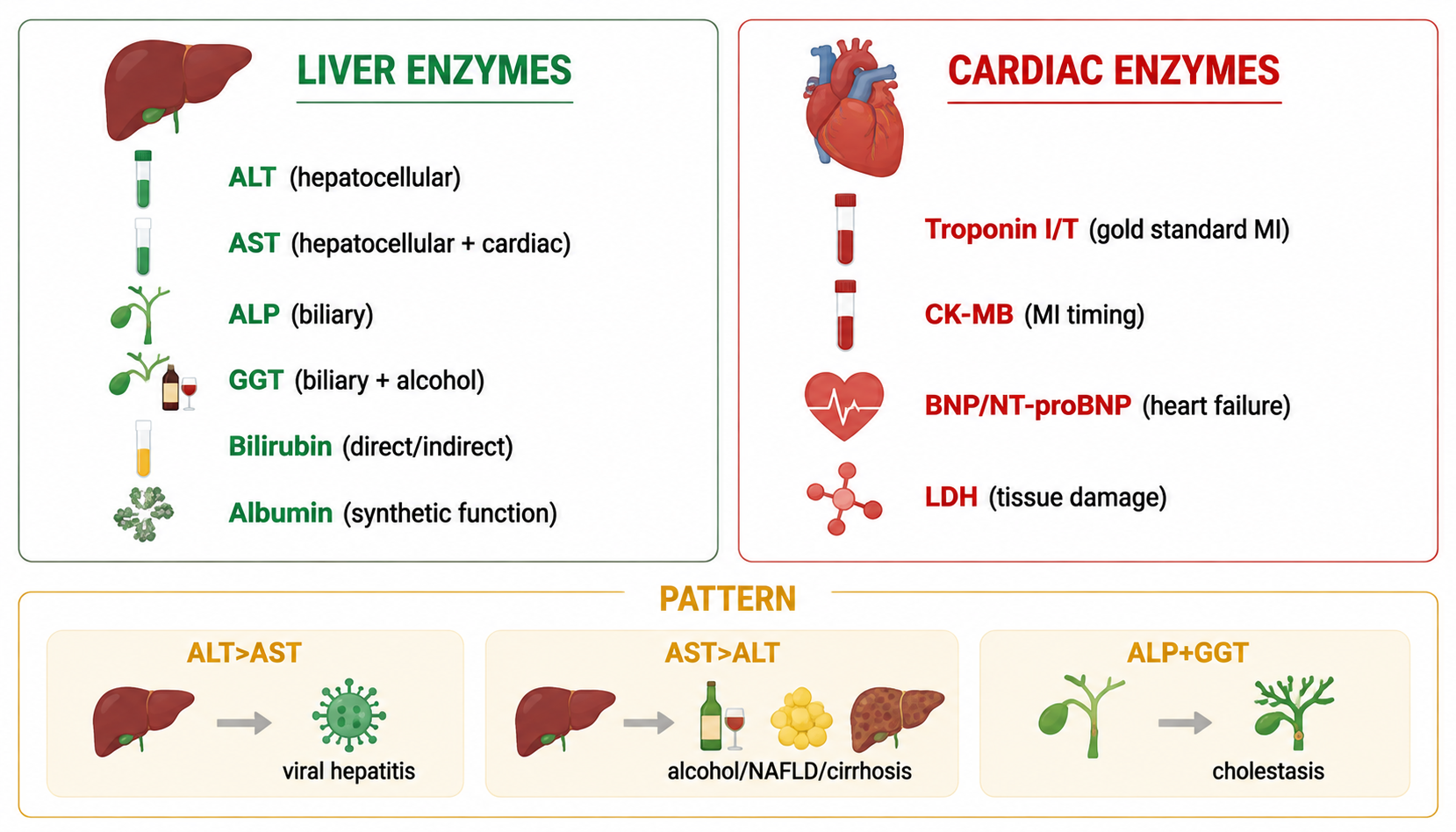
Core Concepts — Clinical Immunology (临床免疫学)
Foundations — "A core, three elements, four labeling technologies"
- A core: antigen-antibody interaction
- Three elements: antigen, antibody, immune cell
- Four labeling technologies: enzyme immunoassay (ELISA), radioimmunoassay (RIA), fluorescence (FIA), chemiluminescence (CLIA)
Antigen & antibody
- Structure: 4 peptide chains (2 heavy + 2 light), variable (V) + constant (C) regions, NH2- and COOH-termini - Ig ≠ Ab: not all Ig have antibody function (myeloma patients have high Ig but not specific Ab)
- Antigen (Ag): substance that induces immune response and reacts with antibody/sensitized lymphocytes (proteins, lipopolysaccharides, nucleic acids)
- Epitope (antigenic determinant): the specific chemical group bound by TCR/BCR and antibody — number, chemical properties, and conformation determine antigen specificity and immunogenicity strength
- Antibody (Ab): globulin secreted by plasma cells that binds specifically to antigen
Immunoglobulins — MUST KNOW
| Ig | Key features |
|---|---|
| IgG | Crosses placenta (passive immunity to newborn); fixes complement (IgG1/3); opsonization; ADCC; most abundant serum Ig |
| IgM | Pentamer, first Ig produced in primary response & in life; good complement fixing; agglutination; half-life 5 days; surface IgM = BCR |
| IgA | Monomer (serum) + secretory IgA (sIgA) dimer in tears/saliva/colostrum/mucus — mucosal immunity |
| IgE | Least common; binds mast cells/basophils Fc receptors → allergy/type I hypersensitivity; clears parasites (eosinophils) |
| IgD | B cell maturation |
Monoclonal antibody (McAb)
- Homogeneous antibody from a single B-cell clone; hybridoma = antigen-primed B lymphocyte × myeloma cell
- High specificity, purity, uniform affinity; binds single epitope
- Clinical: anti-CD20 (rituximab, NHL); anti-HER2 (trastuzumab/Herceptin, breast cancer); humanized antibodies
Immune cells
- T cells (TCR, CD3): cellular immunity — intracellular pathogens (mycobacteria, Listeria, viruses, protozoa); helper CD4, cytotoxic CD8
- B cells: humoral immunity (antibodies); plasma cells produce Ig
- NK cells: ADCC, innate killing
- Macrophages/monocytes: phagocytosis, antigen presentation
- Immunoassay applications: infection serology (HBV markers, HIV, TORCH), tumor markers, autoantibodies (ANA, anti-dsDNA), hormone assays, drug monitoring
TORCH infection (congenital)
Toxoplasma, Other (parvovirus B19), Rubella, Cytomegalovirus, Herpes simplex — cross placenta → miscarriage, stillbirth, premature birth, congenital defects, mental deficiency; screened by clinical immunology
Tumor markers
- AFP: hepatocellular carcinoma, germ cell tumors
- CEA: colorectal, pancreatic, lung cancer (also smokers)
- CA125: ovarian cancer; CA19-9: pancreatic/biliary; CA15-3: breast; PSA: prostate (free/total ratio)
- β-hCG: choriocarcinoma, germ cell
- Tumor markers: not diagnostic alone — used for screening adjunct, monitoring response/recurrence
Core Concepts — Clinical Biochemistry (临床生化)
Definition & samples
- Analysis of body fluids (serum, plasma, urine, whole blood, CSF, sweat) for substrates, enzymes, proteins, ions, amino acids, cholesterol — for diagnosis and therapy
- Venous blood for most; arterial for blood gas (radial/brachial/femoral); capillary for infants/small volumes
- Generally 3–5 ml; anticoagulant per test (citrate = coagulation, EDTA = CBC, heparin = osmotic fragility)
- Serum = plasma − fibrinogen
Cardiac markers — HIGH YIELD (急性心肌梗死)
| Marker | Onset | Peak | Normalization | Notes |
|---|---|---|---|---|
| Troponin (cTnI/cTnT) | 3–6 h | 12–24 h | 7–14 days | Gold standard, most specific; rises in MI, myocarditis, PE, renal failure, sepsis |
| CK-MB | 4–6 h | 12–24 h | 2–3 days | Specific for myocardial injury; useful for reinfarction (returns to normal, rises again) |
| Myoglobin | 1–4 h (earliest) | 6–9 h | 24 h | Highly sensitive early, non-specific (muscle); good negative predictor |
| LDH | 6–12 h | 24–72 h | 7–14 days | Non-specific, late; LDH1 > LDH2 in MI |
| AST | 6–12 h | 24–48 h | 3–6 days | Non-specific (also liver) |
- Troponin = preferred marker; serial measurement (0 h, 3 h/6 h); rise AND fall pattern for diagnosis
- CK-MB ratio (CK-MB/CK >5–6%) supports cardiac origin
- Myoglobin: earliest rise, quickest fall — negative early result helps rule out MI early
- In MI: markers + ECG (ST elevation) + symptoms = diagnosis; troponin T/I elevation = myocardial injury, not always infarction
Liver function tests
| Test | Meaning |
|---|---|
| ALT (SGPT) | Hepatocellular injury (most liver-specific enzyme); ↑ in hepatitis |
| AST (SGOT) | Liver + muscle + heart; AST/ALT >1 in cirrhosis/alcohol |
| ALP | Cholestasis, bone disease (also pregnancy) |
| GGT | Biliary obstruction, alcohol |
| Bilirubin | Total/direct/indirect — classify jaundice (see below) |
| Albumin | ↓ = chronic liver disease, malnutrition, nephrotic syndrome |
| PT | Liver synthetic function (vitamin K factors) |
| Total protein / albumin-globulin | Cirrhosis (A/G reversed), myeloma |
Jaundice biochemistry — classify by bilirubin
| Type | Unconjugated (indirect) | Conjugated (direct) | Urine bilirubin | Urine urobilinogen | Causes |
|---|---|---|---|---|---|
| Hemolytic | ↑↑ | Normal | Normal | ↑↑ | Hemolysis, ineffective erythropoiesis |
| Hepatocellular | ↑ | ↑ | + | +/− | Hepatitis, cirrhosis, drug |
| Obstructive (cholestatic) | ↑ (late) | ↑↑ | ++ | ↓/absent (acholic stools) | Gallstones, tumor, stricture |
- Unconjugated hyperbilirubinemia + no urine bilirubin = hemolysis/Gilbert's
- Conjugated hyperbilirubinemia + dark urine + pale stools = obstruction
- Note: urine bilirubin only appears with conjugated (water-soluble) bilirubin
Renal function biochemistry
- Creatinine (Cr): 44–133 µmol/L (0.6–1.2 mg/dL) — depends on muscle mass; inverse of GFR
- BUN (urea): 3.2–7.1 mmol/L — protein catabolism; ↑ with ↓GFR, high-protein diet, GI bleed, dehydration
- eGFR: calculated from Cr, age, sex, race (CKD-EPI/MDRD); CKD staging by GFR
- Cystatin C: endogenous, better at borderline GFR
- Uric acid: ↑ gout, tumor lysis, renal failure
- Electrolytes: Na, K, Cl, Ca, P, Mg; hyperkalemia = renal failure, tumor lysis, acidosis, hemolysis (peaked T waves on ECG)
Other biochemistry
- Glucose: fasting 3.9–6.1 mmol/L; DM diagnosis (FBG ≥7.0, 2h OGTT ≥11.1, HbA1c ≥6.5%)
- Lipids: TC <5.2, TG <1.7, LDL-C <3.4 (target by risk), HDL >1.0 mmol/L
- Amylase/lipase: acute pancreatitis (lipase more specific, rises earlier/longer)
- Amylase also: salivary, ovarian; macroamylasemia
- Albumin/globulin, A/G ratio: cirrhosis, nephrotic (↓albumin), myeloma (↑globulin)
- Blood gas (arterial): pH 7.35–7.45, PaCO2 35–45, PaO2 80–100, HCO3 22–26 — acid-base interpretation
High-Yield Points
- A core (Ag-Ab interaction), 3 elements (Ag, Ab, immune cell), 4 labeling technologies (enzyme, RIA, fluorescence, chemiluminescence)
- IgG crosses placenta; IgM first in primary response; sIgA = mucosal immunity; IgE = allergy/parasites
- McAb: hybridoma; anti-CD20 (rituximab), anti-HER2 (Herceptin)
- Troponin = gold standard cardiac marker (3-6h rise, 12-24h peak, 7-14d); CK-MB for reinfarction; myoglobin earliest but non-specific
- Serial troponin rise/fall = MI; elevation alone = injury (myocarditis, PE, renal, sepsis)
- ALT = hepatocellular; ALP/GGT = cholestasis; AST/ALT >1 = cirrhosis/alcohol
- Jaundice: hemolytic (indirect↑, urine bilirubin −, urobilinogen↑), hepatocellular (mixed, +), obstructive (direct↑↑, urine bilirubin ++, acholic stools)
- Cr 0.6–1.2 mg/dL; BUN ↑ with ↓GFR; eGFR for CKD staging
- AFP = HCC; CEA = colon; CA19-9 = pancreas; CA125 = ovary; PSA = prostate
- Tumor markers monitor response, not primary diagnosis
LMCHK OSCE Practice
- Cardiac chest pain case: ECG + serial troponin; "troponin elevated with rise and fall → NSTEMI; arrange serial ECGs, cardiology, and risk stratification (GRACE)"
- Biochemistry interpretation: given LFTs → pattern recognition (hepatocellular vs cholestatic); given renal panel → AKI vs CKD (check baseline, ultrasound)
- Hyperkalemia emergency: ECG (peaked T, wide QRS) → calcium gluconate, insulin/glucose, bicarbonate, nebulized salbutamol, dialysis — know the sequence
- Jaundice workup: bilirubin (direct/indirect) + LFTs + USS (bile duct dilatation → obstruction)
- Immunology station: HBV serology interpretation (HBsAg, anti-HBs, HBeAg, anti-HBe, anti-HBc — acute vs chronic vs immunity vs vaccinated)
- Multiple myeloma: rouleaux + hyperglobulinemia + renal failure + anemia + lytic lesions → serum/urine electrophoresis, serum free light chains
Topic Summary
Immunology: Ag-Ab interaction core; Ig classes (IgG placenta, IgM primary, sIgA mucosal, IgE allergy); hybridoma McAb; immune cells (T = cellular, B = humoral); tumor markers (AFP/CEA/CA19-9/CA125/PSA). Biochemistry: cardiac markers timeline (troponin gold, CK-MB reinfarction, myoglobin earliest), liver panel (ALT vs ALP, bilirubin classification of jaundice), renal panel (Cr/BUN/eGFR), glucose/lipids, amylase/lipase. Always interpret in clinical context with serial testing.