Preparatory Mindset
The respiratory examination is the model IPPA exam (Inspection → Palpation → Percussion → Auscultation). Master the chest landmarks (angle of Louis, 2nd intercostal space), the normal breath sounds and their locations, the abnormal sounds with their mechanisms, and how to correlate findings into patterns (consolidation vs effusion vs pneumothorax vs COPD). Vocal resonance adds another layer for consolidation/effusion discrimination. Every finding should trigger a differential.
Illustrations(图解速览)
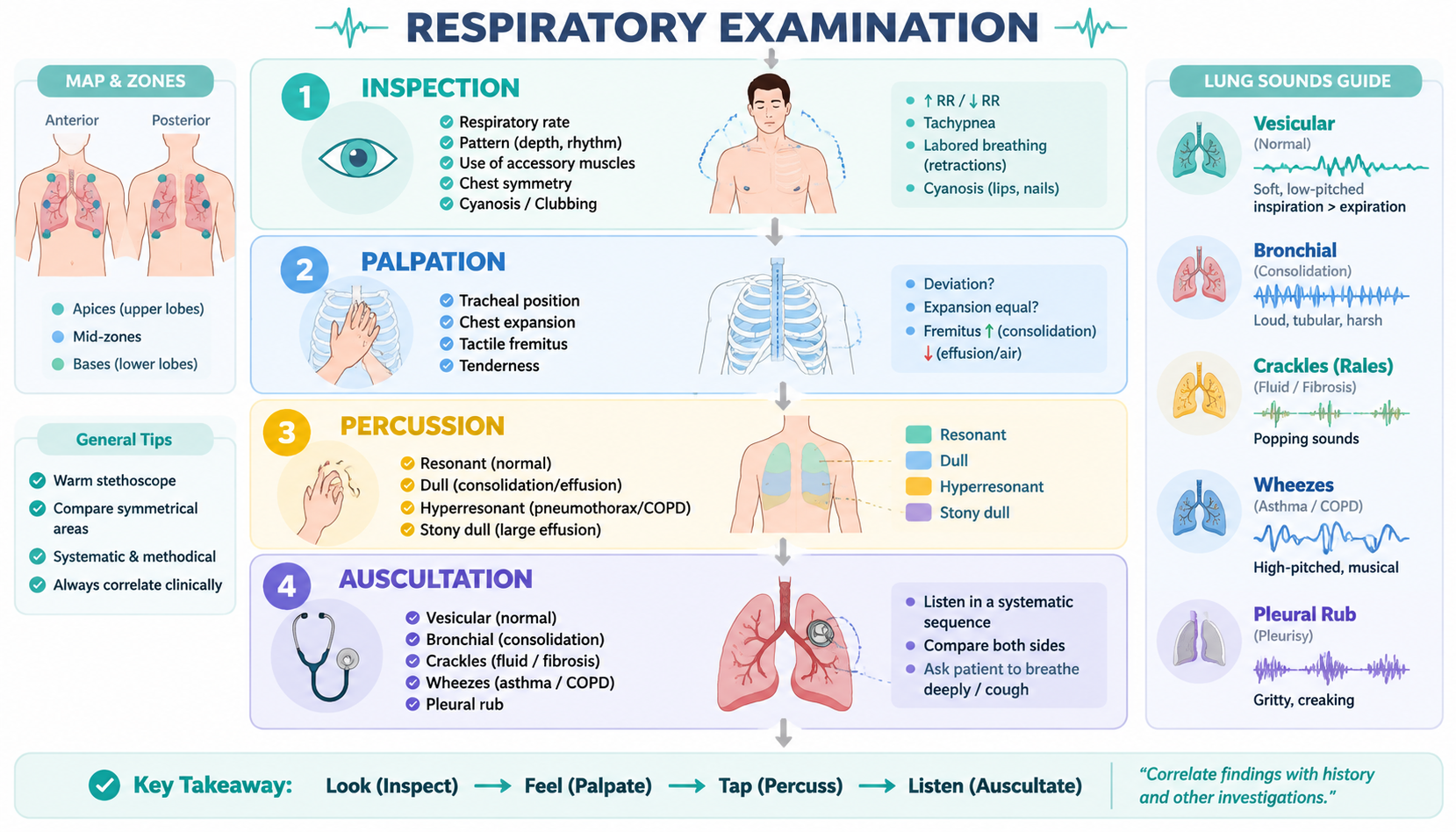
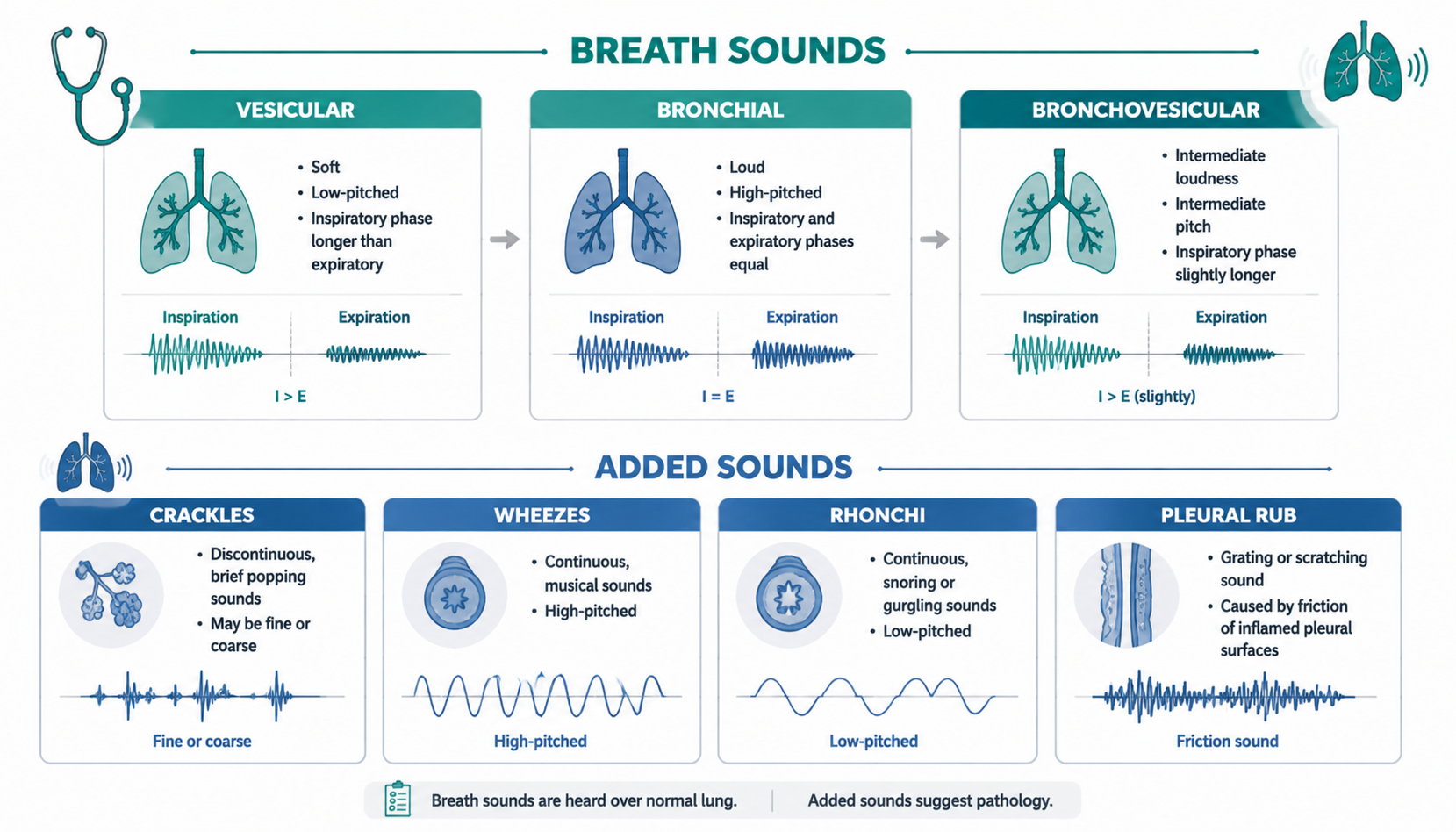
Core Concepts — Landmarks & Anatomy
Anterior landmarks
- Sternal angle (angle of Louis): manubrium-sternum junction, articulates 2nd rib — reference for counting ribs; level of aortic arch, tracheal bifurcation, T4
- Suprasternal notch (trachea palpable); costal margins; midsternal line (MSL); midclavicular line (MCL)
Posterior landmarks
- Vertebral prominence (C7/T1) — count ribs from here; inferior angle of scapula = 7th rib/7th ICS; 12th rib
Reference lines
- Anterior: midsternal, midclavicular
- Posterior: vertebral (midspinal), scapular
- Lateral: anterior/posterior/mid-axillary
Lung borders
- Apex 3–4 cm above inner 1/3 clavicle; base at 6th rib MCL anteriorly, 7th–8th rib laterally, T10 posteriorly (→T12 on deep inspiration)
- Right lung: 3 lobes (upper, middle, lower); left: 2 lobes (upper, lower); right middle lobe doesn't project posteriorly
Pleura
- Visceral (lines lungs) + parietal (lines chest wall/diaphragm) = pleural cavity (negative pressure; lubrication + maintains expansion)
Core Concepts — Inspection (视诊)
General appearance
- Dyspnea: orthopnea, PND (heart failure); nasal flaring, tracheal tugging, retractions, accessory muscle use (distress)
- Cyanosis: central (mucous membranes — lung disease) vs peripheral (extremities — poor circulation)
Breathing patterns — MUST KNOW
| Pattern | Character | Cause |
|---|---|---|
| Tachypnea | >20/min | Fever, pain, anemia, hyperthyroidism, CHF |
| Bradypnea | <12/min | Narcotics/sedatives, ↑ICP |
| Cheyne-Stokes | Crescendo-decrescendo, regular rate irregular depth, periodic apnea | Cortical injury, CHF, drug-induced respiratory depression |
| Biot's (ataxic) | Irregularly irregular, unpredictable apnea | Medullary lesion, ↑ICP, drug-induced |
| Kussmaul | Deep, rapid, labored | Metabolic acidosis (DKA, uremia) |
| Inhibitory | Sudden interrupted inspiration, shallow/fast | Acute pleuritis, rib fracture, chest trauma |
| Sighing | Occasional deep breath | Functional (neurasthenia, stress) |
Chest configuration
- Barrel chest (emphysema, aging), pectus excavatum/funnel (congenital), pectus carinatum/pigeon (childhood asthma, rickets, ASD/VSD), kyphosis/scoliosis/kyphoscoliosis (restrict lungs)
- Asymmetry: skeletal deformity, prior surgery, unilateral intrathoracic disease
- Asymmetric chest expansion = unilateral lung/pleural disease (affected side lags)
Clubbing
- Widening of terminal phalanges, nail angle >180°, shiny stretched periungual skin, nail-bed fluctuation
- Causes: intrathoracic malignancy, suppurative lung disease (abscess, bronchiectasis, empyema), diffuse interstitial fibrosis, cirrhosis (esp. PBC), IBD, cyanotic CHD
Core Concepts — Palpation (触诊)
Chest wall
- Nodules, crepitus (subcutaneous emphysema — spongy feel; rib fracture, pneumothorax drainage, esophageal rupture), tenderness (rib fracture, costochondritis — reproducible)
- Venous collaterals + flow direction: caudad flow = SVC obstruction; cephalad flow = IVC obstruction
Tracheal position — HIGH YIELD
- Deviation away from affected side = space-occupying (tension pneumothorax, effusion, tumor) — mediastinum pushed
- Deviation toward affected side = volume loss (atelectasis, fibrosis, post-pneumonectomy) — mediastinum pulled
Chest excursion
- Hands at 10th ribs, thumbs midline, ask deep breath — symmetric movement normal; unilateral decrease = localized disease
Tactile fremitus (语颤)
- Palpable vibration from phonating larynx; ask "ninety-nine (99)"; compare sides
- Stronger in men/adults, upper & anterior chest
| Change | Causes |
|---|---|
| Decreased | Emphysema (more air), bronchial obstruction (atelectasis), massive effusion/pneumothorax, pleural thickening, subcutaneous emphysema/edema, obesity, pneumonectomy |
| Increased | Consolidation (lobar pneumonia, pulmonary infarction), pulmonary cavity (TB, lung abscess), compressive atelectasis |
Pleural friction fremitus
- Inflamed pleura rubbing — pleurisy (cellulose exudate); disappears on breath-holding; TB pleurisy, uremia, PE
Core Concepts — Percussion (叩诊)
Method
- Indirect: pleximeter (left middle finger distal IP joint) + plexor (right middle fingertip); wrist-only movement, strike vertical, lift immediately
- Order: up-down, anterior-posterior; compare sides
Percussion notes — MUST KNOW
| Note | Sound | Over/Causes |
|---|---|---|
| Resonance (清音) | Normal | Normal lung |
| Hyperresonance (过清音) | Louder, lower | Emphysema |
| Tympany (鼓音) | Drum-like | Gastric bubble, pneumothorax, large cavity |
| Dullness (浊音) | Soft, short | Heart/liver (normal), pneumonia, effusion, TB, edema, tumor |
| Flatness (实音) | Very dull | Massive effusion, massive atelectasis, consolidation, non-liquefied abscess |
- Lesion not detected by percussion if depth >5 cm or diameter <3 cm (or mild effusion)
- Kronig isthmus (lung apex): normally 5 cm wide — narrowed (TB, fibrosis), widened (emphysema)
- Lung lower border: 6th ICS (MCL), 8th (MAL), 10th (scapular line) — downward shift (emphysema), upward (atelectasis, ↑intra-abdominal pressure)
- Diaphragmatic excursion: decreased in emphysema, atelectasis, fibrosis, pulmonary edema, pneumonia; undetectable in adhesion, massive effusion, pneumothorax, paralysis
Core Concepts — Auscultation (听诊)
Normal breath sounds
| Sound | Location | I:E | Character |
|---|---|---|---|
| Tracheal | Extrathoracic trachea | 1:1 | Loud, harsh, coarse, tubular |
| Bronchial | Larynx, suprasternal, 6th/7th C, 1st/2nd T vertebra | 1:3 | Loud, high-pitched, hollow, prolonged expiration |
| Bronchovesicular | 1st–2nd ICS beside sternum; 3rd–4th T interscapular; lung apex | 1:1 | Soft, breezy, medium |
| Vesicular | Most of lungs | 3:1 | Soft, smooth, rustling; expiration shorter/softer |
Abnormal breath sounds
| Finding | Meaning |
|---|---|
| Vesicular decreased/disappeared | Limited chest wall movement, muscle weakness, airway obstruction, compressive atelectasis, effusion/pneumothorax, ascites/large tumor |
| Vesicular increased | Exercise, fever, anemia, metabolic acidosis, compensatory (single lung) |
| Prolonged expiration | Incomplete obstruction / ↓alveolar elasticity: bronchitis, asthma, emphysema |
| Abnormal bronchial (tubular) sound in vesicular area | Consolidation (lobar pneumonia), large cavity (TB, lung abscess), compressive atelectasis (effusion, pneumothorax) |
| Abnormal bronchovesicular | Bronchopneumonia, TB, early lobar pneumonia, upper area of effusion |
Adventitious sounds
Crackles (湿啰音, discontinuous): explosive opening of collapsed airways / bubbles bursting in secretions
- Fine: bronchioles — bronchiolitis, pneumonia, pulmonary congestion/embolism, fibrosis ("Velcro"), crepitus (early pneumonia, elderly bedridden)
- Medium: bronchi — bronchitis, bronchopneumonia
- Coarse: trachea/main bronchi/cavity — bronchiectasis, pulmonary edema, TB, lung abscess, coma
- Fine crackles = high-pitched, end-inspiration, don't clear with cough (edema, pneumonia, fibrosis); coarse = low-pitched, early inspiration, may clear with cough (bronchitis, bronchiectasis)
Rhonchi/wheezes (干啰音, continuous): turbulent flow through narrowed airways (congestion, secretion, spasm, tumor, foreign body, compression)
- Wheeze (哨笛音): high-pitched, musical, mostly expiratory — asthma (reversible, bilateral), COPD (persistent), cardiac asthma (acute LHF); local wheeze → tumor, endobronchial TB
- Rhonchus (鼾音): low-pitched, snoring, larger airways, may clear with cough — bronchitis, bronchiectasis
| Feature | Rhonchi (wheezes) | Crackles |
|---|---|---|
| Mechanism | Turbulent flow, narrowed airway | Bubbles/opening collapsed bronchioles |
| Phase | Expiration dominant, variable | Inspiration or early expiration, constant |
| Character | Musical/continuous, variable intensity | Discontinuous, popping, constant site |
Vocal resonance (语音共振)
- Ask patient to say "ninety-nine" while listening
- Increased: consolidation → bronchophony (clear speech), pectoriloquy (massive consolidation), egophony ("e"→"a") at upper effusion border, whispered pectoriloquy (consolidation)
- Decreased/absent: effusion, collapse, pleural thickening, emphysema
- Pleural friction rub: grating, leathery, both phases, breath-holding stops it (pleurisy, uremia, PE)
High-Yield Points
- IPPA order; abdomen exception (auscultate first)
- Consolidation (lobar pneumonia): ↓expansion, ↑fremitus, dullness, bronchial breath, ↑crackles, ↑vocal resonance, egophony
- Pleural effusion: ↓expansion, ↓fremitus, dullness→flatness, ↓breath sounds, ↓vocal resonance; trachea away if massive
- Pneumothorax: hyperresonance/tympany, ↓fremitus, ↓breath sounds; trachea away (tension)
- Emphysema/COPD: barrel chest, hyperresonance, ↓fremitus, ↓breath sounds, prolonged expiration, wheezes
- Kussmaul = metabolic acidosis; Cheyne-Stokes = CHF/cortical; Biot's = medullary/↑ICP
- Clubbing: angle >180°; causes — lung cancer, bronchiectasis, lung abscess, empyema, fibrosis, cyanotic CHD, cirrhosis
- Tracheal deviation: away = mass, toward = collapse
- Tension pneumothorax: trachea away + hypotension + distended veins — needle decompression, no waiting
LMCHK OSCE Practice
- Respiratory short case (8 min): common cases — lobectomy scars, bronchiectasis, pulmonary fibrosis (autoimmune); comment on breath sounds: inspiratory/expiratory phase, intensity, added sounds, vocal resonance
- Exam sequence: consent/hand hygiene → general inspection (dyspnea, cyanosis, clubbing, scars) → count RR → trachea → expansion → tactile fremitus → percussion (apex to base, compare) → auscultation (both phases, compare) → vocal resonance → comment
- Tell the examiner what you would look for on the back (percussion/auscultation posterior)
- Post-exam: offer to check clubbing, JVP, sacral edema (heart failure signs)
- Comment on trachea: "Trachea is central; no deviation" (or away/toward + cause)
Topic Summary
Respiratory exam = IPPA. Inspection: breathing patterns (Kussmaul/Cheyne-Stokes/Biot's), chest shape, clubbing, asymmetric expansion. Palpation: tracheal position (away=mass, toward=collapse), tactile fremitus (↑ consolidation, ↓ effusion/emphysema). Percussion: resonance→hyperresonance (emphysema/pneumothorax), dullness (consolidation/effusion), flatness (massive effusion). Auscultation: 4 normal sounds, tubular breath in consolidation, crackles (fine/coarse), wheezes (asthma/COPD), vocal resonance (bronchophony/egophony) (17CM exam tested). Correlate findings into the 4 classic patterns — consolidation, effusion, pneumothorax, emphysema.